Zohran Mamdani has emerged as New York City’s newest political force. Despite 26 billionaires trying to thwart Zohran Mamdani’s rise via a $22 million concerted effort, the Democratic socialist became New York City’s next mayor.
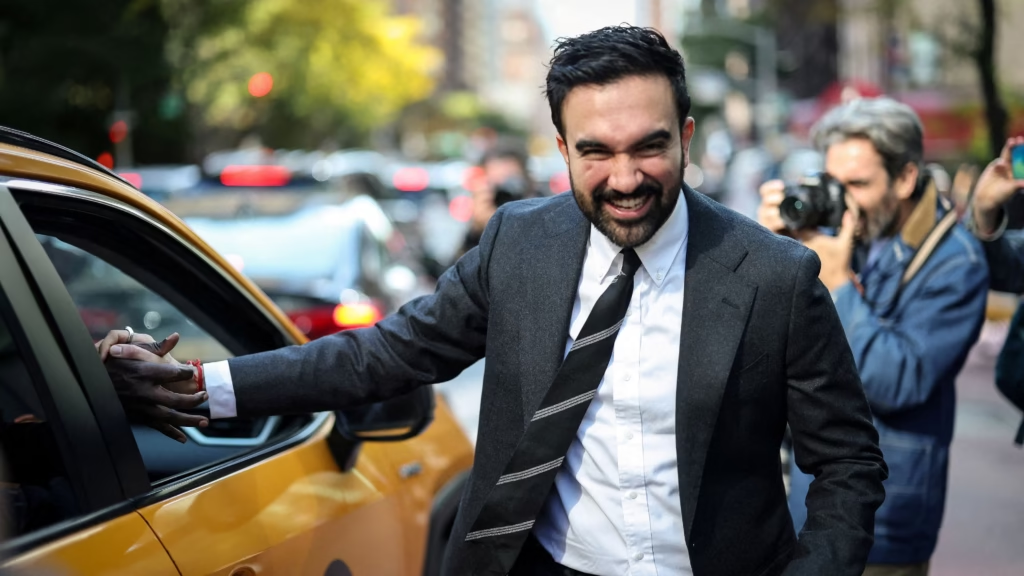
Mamdani’s agenda resonated with voters because, while he was running to be mayor, they understood that New York was spiraling out of control with the rising cost of living, and he laid out a progressive platform that included free public transport and universal child care to ease the burden on hard-working families in New York.
As a redistributionist with a penchant for critiquing corporate entities, it is easy to understand why the affluent opponents viewed Mamdani with disdain.
Zohran Mamdani Defies Billionaire Opposition to Win New York Mayoral Race
A report by Forbes revealed that America’s richest families came together to spend more than $22 million to defeat Mamdani. They funded competing candidates and financed attack ads against Mamdani’s movement. Well-known donors included Michael Bloomberg, Bill Ackman, Joe Gebbia, and people from the Lauder family. They each gave at least $100,000 to committees and political action groups that supported former Governor Andrew Cuomo. Bloomberg alone gave $8 million to support Cuomo during the Democratic primary race.
Ackman gave $1.75 million, and William Lauder contributed $750,000 to the campaigns against Mamdani.
At least $13.6 million, more than half of all the money, came in before Mamdani won the Democratic primary on June 24. Bloomberg’s donation of $8.3 million to Fix The City, Inc. in June nearly made up all of the pre-primary fundraising totals.
Billionaires’ $22-Million Campaign Against Zohran Mamdani
In addition to Mamdani’s progressive efforts, Reed Hastings and Barry Diller each donated $250,000 to combat the Mamdani progressive push. Afterward, conservative donors followed suit, increasing elite opposition across party lines. In October, casino mogul Steve Wynn donated $500,000, and oil magnate John Hess pledged $1 million over the first months. At an event with supporters on October 13th, Mamdani included the billionaires in his speech.
He said, “Billionaires like Bill Ackman and Ronald Lauder have spent millions of dollars because they say we’re an existential threat. I’m here to own it: they’re right.” Forbes reported that 16 of the 26 billionaire donors lived in New York City. The ten biggest contributors alone spent more than $20 million against Mamdani.
Grassroots Power Surpasses Wealth and Influence
Mamdani leveraged his grassroots campaign despite the major funding deficit and encouraged voters who wanted economic justice. He unified working-class residents, young progressives, and organized labor advocates who wanted structural change. His success demonstrated the potentially diminishing political power of corporate elites in the New York electorate. To observers, his win represented a shift towards a more populist urban agenda.
Even his most ardent opponents calmed down after the
Critics from Wall Street Offer Support after Victory
Fortune reported that a number of Wall Street personalities offered celebratory gestures following Mamdani’s substantial victory. Ackman commented on X as follows: Now you have a big responsibility. If I can help NYC in any way, please inform me as to what might be helpful.
JPMorgan Chase’s CEO Jamie Dimon, who said previously that Mamdani is “more Marxist than socialist,” only said that he is open to talking to some extent.
Mamdani won the campaign. Dimon spoke with CNN on November 5, following Mamdani’s victory, and stated that he is open to following up.
“If I find it productive, I’ll continue to do it,” he stated, and “If someone were mayor, or a governor, if they find it productive, etc.”.
A New Era for New York City
Mamdani’s tenure begins on January 1, 2026, and he promises to change New York’s economic and social vision.
Mamdani’s rise from grassroots activism to City Hall is a historic moment for progressive politics in America.
Analysts attribute some of Mamdani’s success to the growing urban support for policies reflective of economic equity, affordability, and public ownership.
Mamdani showed that ordinary New Yorkers can combine to show that even billionaire money cannot always buy political power.
For more- https://civiclens.in/category/international-news/
About the Author