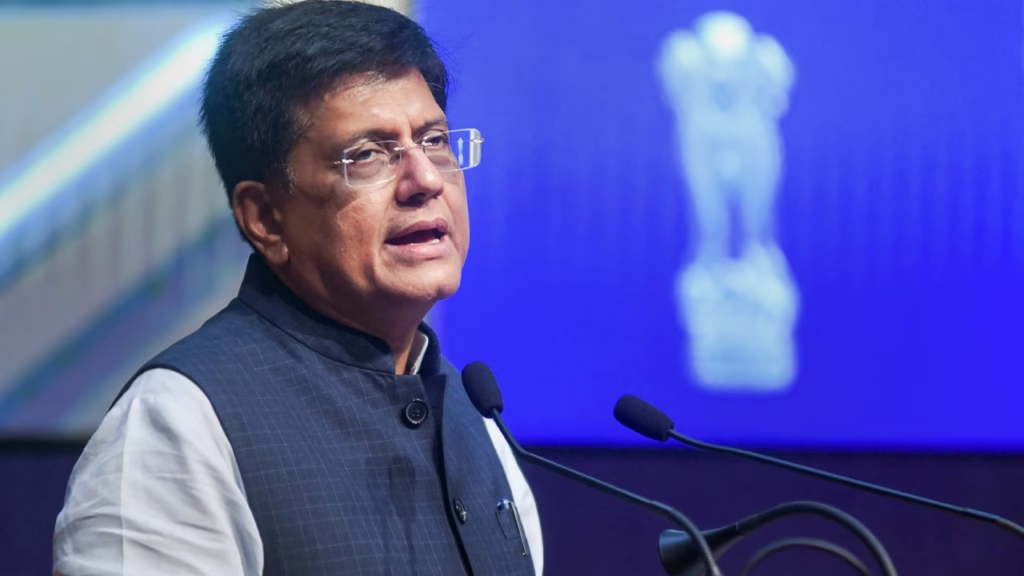
Piyush Goyal, the Minister for Commerce and Industry, indicated on Tuesday that India is aiming for a fair, equitable, and balanced trade agreement with the United States, but it won’t sacrifice the interests of its farmers, fishermen, workers, and the dairy sector. During an address at Udyog Samagam 2025, a meeting of state industry and commerce ministers, Goyal noted India is determined to arrive at an agreement that benefits both parties while also addressing national priorities.
“We are working towards a good trade agreement, in the interest of India. At the same time, India is not going to, for the interest of our farmers, fishermen, workers, labour, and our dairy… we are working on a trade agreement that is fair, equitable, and balanced,” Goyal stated.
The comments from the minister come as negotiations between India and the US continue to progress around their intention to finalize the first tranche of the bilateral trade agreement by Fall 2025.
Bilateral Trade Negotiations Move Forward, but Tariff Issues Remain
India and the United States have engaged in five rounds of trade discussions to date. In mid-October, a delegation of Indian officials, led by Commerce Secretary Rajesh Agrawal, visited Washington, D.C. for another round of talks. The most recent talks lasted from October 15-17 and resulted in discussions on topics of market access, tariff issues, intellectual property, and agricultural cooperation.
An official familiar with the negotiations commented that India has been very careful in negotiations and, as they have in other settings, made sure that whatever they are negotiating conforms with World Trade Organization (WTO) practices.
India has had the most comprehensive and WTO-compliant negotiations of any other country. We have acted in good measure to protect our sensitive interests, minding our negotiation process,” the official said.https://www.businesstoday.in/india/story/piyush-goyal-on-india-us-trade-deal-wont-compromise-interests-of-farmers-dairy-501776-2025-11-11
The negotiations are notable as trade relations between New Delhi and Washington have soured recently after the prior Donald Trump administration imposed high tariffs on Indian imports. The United States retains a 50 per cent tariff rate; it also imposed a 25 per cent duty on imports of Russian crude oil sourced from India.
Aspiring to Increase Bilateral Trade to $500 Billion
Despite some trade tension, both sides are optimistic about finalizing an agreement in the near future. President Donald Trump commented that the US is “fairly close” to securing a “fair trade deal” with India, implying the US could reduce additional duties after an agreement was made.
India is aiming to reach $500 billion in bilateral trade by 2030, up from $191 billion. The US has remained India’s largest trading partner for the fourth year in a row, with bilateral trade worth $131.84 billion in 2024-25, with exports worth $86.5 billion.
As per the commerce ministry, India’s merchandise exports to the US fell 11.93 per cent to $5.46 billion in September due to high tariffs, while imports increased 11.78 per cent to $3.98 billion.
Expanding Export Markets in Response to Trade challenges
Due to tariffs, India is seeking new export countries, including Russia, to develop its fishery sector, which has suffered from high import duties in the United States. Goyal stated that the diversification is part of broader trade resilience for India.
“We are looking for new markets such as Russia for our fisheries and other export sectors facing tariff issues,” he said.
The minister cautioned that while India is not against cooperation, any trade agreement would have to protect the livelihood of millions of Indians. “If the deal happens, it could happen any day — tomorrow, next month, or next year,” Goyal said. “But we won’t sign anything that hurts our farmers or workers.”
As both sides continue to prepare for another round of negotiations, the new trade agreement with the United States, which both sides see as a significant achievement that could reshape one of the most vital economic relationships in thae world, if reasonable, as Goyal says, “fair, equitable, and balanced.”
FOR MORE: https://civiclens.in/category/national-news-civiclens-in/
About the Author


