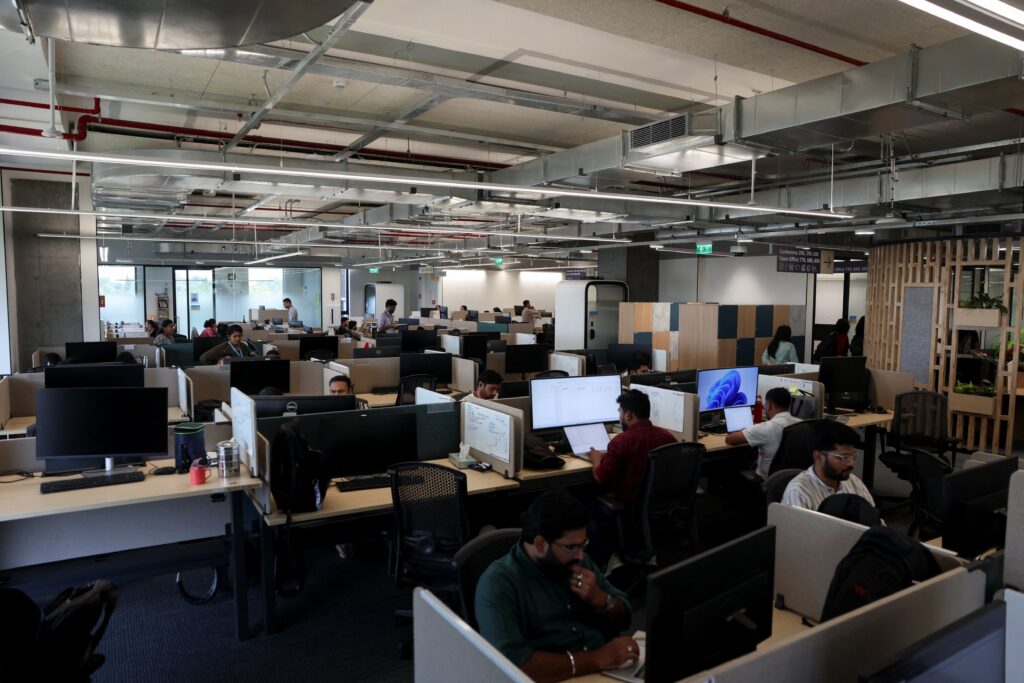
The H-1B policy under Donald Trump has set off worldwide alarm, triggering confusion among skilled workers, students, and US employers. He argued that it is impossible for currently unemployed Americans to step into roles with a sophisticated level of skill in defence or technology sectors without an extensive track record of training. Trump also pointed out that the United States “doesn’t have enough talent” to backfill specialized roles, suggesting no US workers could fill the H-1B role gaps. He made these statements in a Fox News interview to defend the need to be able to “bring in talent” into important US roles.
Trump’s H-1B Policy Sparks Nationwide Confusion
But Trump’s clarification came after the storm, and he and his administration shocked global technology workers with a very steep fee increase for new H-1B applications. The fee increased to $100,000 for new applications, shocking employers across Silicon Valley and thousands of workers from India who depend on the H-1B option. Companies quickly advised employees against any travel abroad, and immigration lawyers worked to try to get a handle on the recent changes. It was later clarified that the new fee only affects new applicants. However, the new fee will undoubtedly weigh heavily upon a system that helps to support some of the largest industries in the United States.
India’s Deep Stake in the H-1B Policy Pipeline
Indians comprise the bulk of the H-1B workforce and receive over seventy percent of approved visas. This has impacted India and the United States. For India’s H-1B visa holders, families rose to the middle class and established substantial service sectors. For the United States, Indian talent occupied its R&D laboratories, hospitals, universities, and tech unicorns. Today, Indian origin-educated leaders operate Google, Microsoft, and IBM. Of the US doctor workforce, almost six percent of physicians are of Indian origin, underscoring how crucial this pathway remains.
Why the Fee is Impossible
Experts are skeptical, suggesting a $100,000 fee is impossible, since the median wage cut-off for new H-1B workers is much below that. Many new hires will simply choose not to apply, and the consequence will be talent shortages in the long run. Analysts are warning that the United States is facing some deeper shortages in medicine, engineering, and research functions. They also note this could limit the United States on the global stage and see skilled workers leave for friendlier countries.
Crackdown Worsens Anxiety
Trump’s comments came in the larger context of a crackdown on both H-1B applications and their limits within the country. The whole Trump administration had over 175 investigations into H-1B misuse under “Project Firewall”. Florida banned H-1B hires in state universities, stating that full-panel H-1B students were taking its workers. The White House repeated “our goal is to one hundred percent put American workers first”, when whole industries were warning of serious gaps in labour.
Economic & Educational Consequences
Indian IT companies have already begun to lessen their reliance on the US economy by moving work offshore. Hospitals in the United States will risk worse physician shortages as new graduate international medical students return home, and many universities will feel the blow, given that Indian students represent one out of every four international students. Many are concerned that if the tuition costs increase, it will destroy any possibility of going from student to skilled worker. Several groups of students were warning that the raise feels like a direct attack, especially on the heels of paying large tuition costs.
It’s a Policy That Could Hurt America More
Economists warned that the US risks losing billions, as H-1B families contribute around 86 billion dollars to the economy. Legal experts expect the legal challenges leading up to this policy to come soon, while analysts warned that most of the exemptions for large corporations could undermine the purpose of the policy itself. As the episode continues to evolve, most agree that the United States could lose more than India in allowing skilled workers to seek opportunities elsewhere.
For more- https://civiclens.in/category/international-news/
About the Author