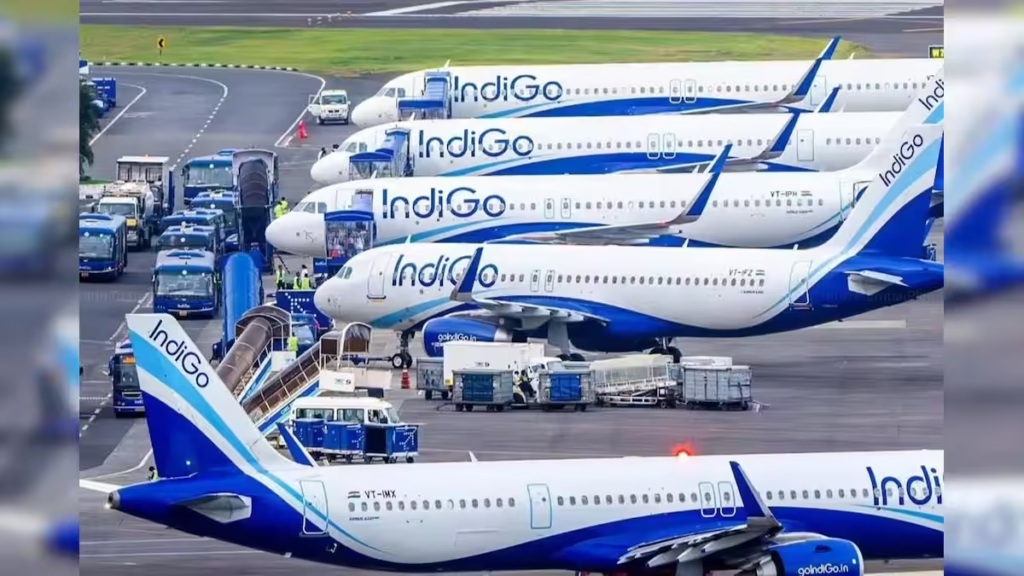
The IndiGo Airline continues to experience issues due to both financial and logistical reasons. After the government imposed stricter regulations for workload, operators such as IndiGo could no longer meet their legal obligations. Consequently, due to IndiGo’s massive number of flight cancellations, it is exposed to many faults within the Company’s Crew Scheduling Program. What started out as a small number of flight cancellations has escalated into an ongoing crisis where the company struggles to meet its daily flights.
The essential reason behind IndiGo’s troubles is due to the union between two regulations: old workload rules that IndiGo could work with, and the new rules that IndiGo could not meet. A couple of months ago, as of June 2023, the DGCA suspended these new regulations and effectively went back to a system that the regulators had determined to be unsafe two years ago.
Increase in the weekly rest
Old rule: 36 hours of rest
New rule: 48 hours of continuous rest
The thinking behind the new regulation was that by allowing pilots to rest more hours, they are safer.
However, the additional rest also required that airlines employ more pilots in order to provide the same capacity of operations. IndiGo did not have these pilots available.
Broadening of Definition of Night Duty
Old rule: Night Duty is defined from midnight to 5 am (12am – 5 am)
New rule: Night Duty will be defined from midnight to 6 am (12am – 6 am)
An increase of one hour of duty in the Night Duty definition requires changes in many many of the existing pilots’ rosters. As a result, IndiGo needed hundreds of additional pilots to facilitate the change.
Decrease in Maximum Night Duty Hours
Old rule: Pilots can work 13 hours of continuous night duty
New rule: Pilots will work no more than 10 hours of continuous night duty
Pilots can only work three less hours of flight duty per night, which will create additional crew shifts.
IndiGo did not have sufficient number of crew to accommodate the additional shifts.
Limitation of Night Landings
Old rule: Pilots could make six night landings
New rule: Pilots will make a maximum of two night landings
This will require the rotation of pilots to operate at more than one airport every night.
IndiGo did not have the workforce needed to accomplish this task safely.
Mandatory fatigue risk management
Airlines must now establish a system of Fatigue Risk Management (FRM), an internationally recognised safety tool for keeping track of the true state of fatigue of their pilots.
IndiGo was not positioned to migrate to the new system due to not being able to secure a crew complement that was compliant with the new required standards.
Figures for the shortfall of IndiGo’s crew
According to Statistics from the Directorate General of Civil Aviation (DGCA), IndiGo was deficient by 1140 Pilots to meet the current Regulations:
935 Captain Pilots (PIC)
205 First Officer Pilots.
In an industry where pilots are essential to operate the aircraft, the crew deficiency level is staggering. It takes a significant time to train, educate, and qualify pilots. It is not as simple as just hiring a few more pilots.
By expanding at such an aggressive rate, without recruiting additional pilots, IndiGo created a situation to which it was pressed into a corner. Thousands of IndiGo flights were grounded due to the enforcement of the new regulations.
The chaos at the airports

The result was a complete operational shutdown of IndiGo across the country.
Angry and frustrated passengers waited at major airports as numerous flights later cancelled at the last minute. Over two hundred flights cancelled within a few hours in Delhi alone on that one particular day. Passengers missed their wedding, work, and International Flights.
One of the flyers stuck at the airport referred to it as a “complete failure” because IndiGo had not provided any timely communication.
The recent decision by the regulator to remove the new regulations temporarily was a matter of life and death for IndiGo Airlines, since without this removal, IndiGo would be unable to operate flights.
ALSO READ: India, Russia ink new pacts to boost trade, energy and defence ties
The reversion back to previous rules brings back:
- 36 hours of weekly rest
- The definitions of night work as it existed prior to the new regulations
- The prior definition of the 13-hour night working window
- A maximum of 6 night landings
- The lack of a requirement of fatigue reports for pilots
By reverting to these prior rules, IndiGo has the ability to continue to use existing rosters and is now in a position to fly with the present pilots that they have.
When should we expect normal operations to resume?
According to IndiGo and DGCA officials:
- Partial recovery: within 24 hours
- Full recovery of roster: within 3 days
- IndiGo expects their schedules will return to normal once pilots are re-assigned under the prior rules.
The event described in this article is a direct result of many years of poor management and development of safety regulations in India.
The current situation highlights how difficult it is to balance safety and scheduling in many areas of aviation today. Last year, the DGCA changed the way that they regulated pilots and passengers in order to protect them better. However, IndiGo’s growth has been faster than IndiGo’s ability to recruit and train crewmembers.
The result is where safety does not coincide with real world operations and thus cause a breakdown of the safety regulations implemented.
Today, all companies that operate in India must comply with rules that are considered old time and that are currently not being used by the only airline that services the entire country safely.
FOR MORE: https://civiclens.in/category/national-news-civiclens-in/
About the Author