The education regulation bill proposes a sweeping overhaul of India’s higher education system by restructuring regulation, accreditation, and funding control. Introduced in Parliament, the bill seeks to replace multiple regulators with a single authority, triggering political debate over centralisation and academic autonomy. The government has proposed a new law that will completely change the way that higher education is regulated in the entire country. Under this law, a single organization will be created to replace several existing organizations that currently perform similar functions. Included in the proposed organization would be the functions of the University Grants Commission, the All India Council for Technical Education, and the National Council for Teacher Education. Additionally, Education Minister Dharmendra Pradhan presented the proposed legislation during the Winter Session of the Parliament.
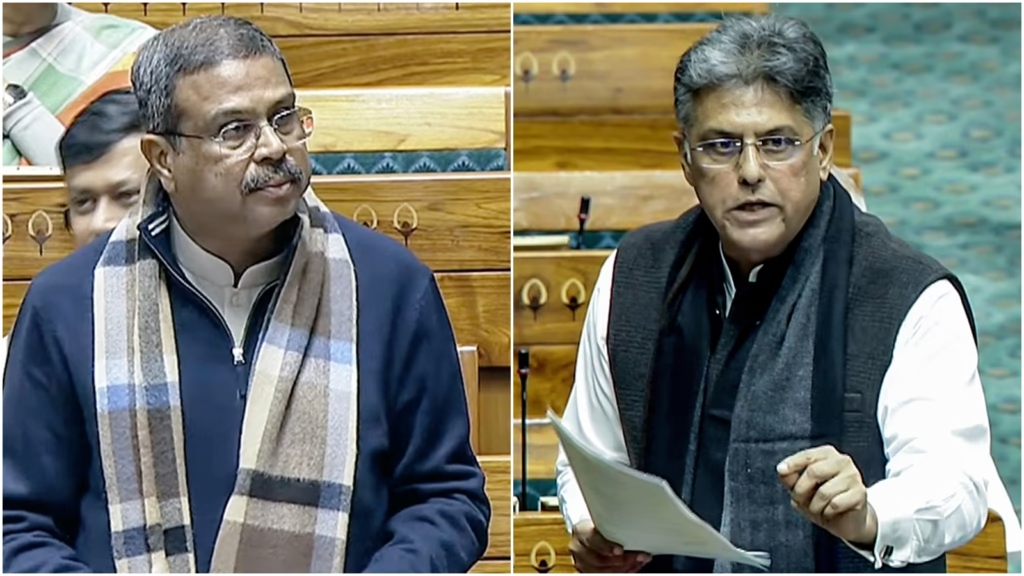
The proposed legislation establishes the Viksit Bharat Shiksha Adhishthan (VBSHA) as the highest authority on higher education in India. Three separate councils will oversee the regulation, accreditation, and academic standards of institutions. The Indian government has proposed that the consolidation of the various regulatory authorities will eliminate duplication of services and improve the ability to govern effectively. In addition, it has also proposed thatan outcome-based accreditation process will improve the accountability of the institutions.
Why did funding control in the education regulation bill triggered opposition
It transfers funding for post-secondary learning directly to ministries of education. Those opposed see this as an increase in the Federal Government’s central control over post-secondary institutions. They believe that the institutions are likely to receive demands for compliance without any guarantee of financial assistance. As such, Opponents have said that by not being able to control the granting of scholarship funds, Regulators will lose their independence as Regulators, and ultimately, that teachers’ unions fear that their academic independence and their freedom as institutions will be eroded.
The Bill had its name changed to Hindi due to objections raised by Members of Parliament with respect to certain provisions in the Constitution pertaining to the use of language. Subsequently, the Bill was then referred by the House to a Standing Committee for further study, which delayed its progress, but also increased the intensity of the discussion regarding the concentration of powers within the Federal Government.
Structure scope penalties and broader implications
The Establishment of a Centralised Search Panel to Appoint New Members of the Commission and of all Central Universities, IITs, NITs, and Private Universities will apply to all of These Institutions. Additionally, Authorised Institutions That Have Been Found to be Committing Violations on Multiple Occasions Will Be Fined Up to Crores or Have Their Institutional Operations Suspended (Tiered Autonomy Provides Incentives for Institutions to Perform Well and Increase Innovation) and Will Not Cause Any Decrease in Institutional Quality, According to Supporters.
The Implementation of Uniform Regulation Will Also Dilute the Standards of Excellence of World-Class Institutions (e.g., IIT, NIT). Experts suggest a Cooperative Implementation of the proposed reforms that would respect state responsibilities while allowing for Institutional Diversity. The Required Balance Between Efficiency, Transparency, and Academic Independence Within Institutions to Enable Effective Resource Allocation Will Ultimately Be Determined by the Recommendations of the Committee During its Review of the Proposed Legislation Prior to the Parliamentary Consideration of the Legislation to Resume. The Final Results of the Implementation of the Proposed Legislation Will Directly Affect the Governance Stability and Funding Certainty, and Direction into National Higher Education.
For more- https://civiclens.in/category/national-news-civiclens-in/
About the Author




1 thought on “Education regulation bill redraws control over funding and universities”