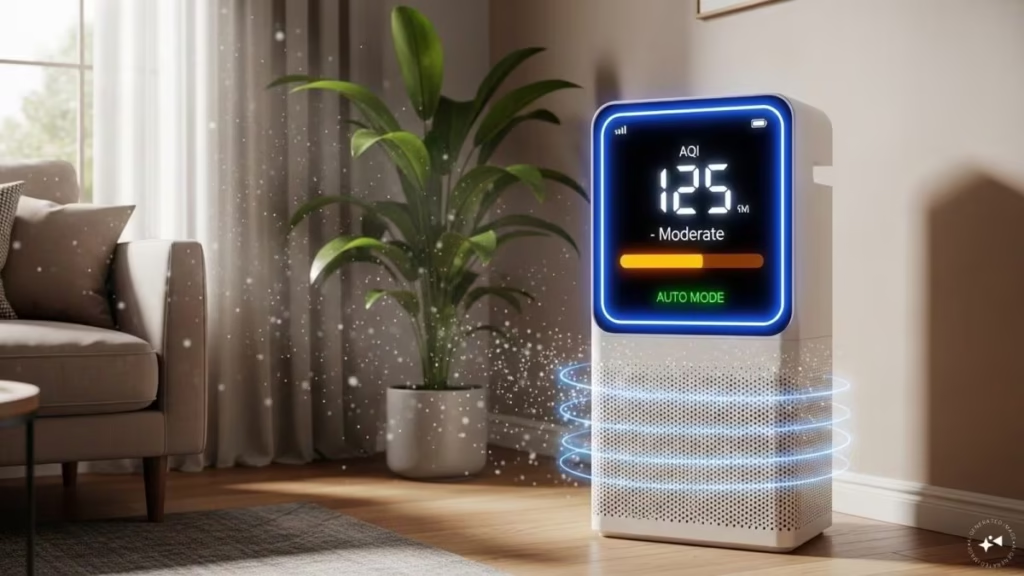
The Delhi High Court has called for a meeting of the GST Council on the possibility of a reduced rate of, or a waiver of, the GST on air purifier devices, in view of the levels of air pollution being experienced in the Delhi NCR regions. As of now air purifier devices attract a rate of GST of 18%.
“Air purifiers fall under the ‘medical device’ category, so like every other crucial device, a 5% tax rate can be imposed,” reads the order based on a case where it has been argued in a petition that air purifiers classify as medical devices. “Air can no longer be a luxurious product; air is a necessity of life,” says lawyer Kapil Madan. In a city where, suffice it to say, the air quality at times hits ‘very poor’ or ‘severe’ categories, air purifiers can no longer be a luxurious product, when discussing the need to implement a 5% tax rate on air purifiers.
The court points out the importance of speed in the verdict due to environmental pollution deterioration. Because environmental pollution has deteriorated to a serious.
The demand for speed
Noting that “a report of the Parliament Standing Committee has been submitted in December of this year itself,” Chief Justice Devendra Kumar Upadhyaya and Justice Tushar Rao Gedela of the bench appeared to mean: “It has been recommended in the report that GST on air purifiers and HEPA filters should be dealt with with sympathetic considerations. The presence of situations prevailing on air quality will suffice to have meetings of the GST Council held on-line.”
“If the government does not have control over the quality of air we breathe, then at least reduce the GST rate on air purifiers,” said the Bench and further asked that “the Council should meet at the earliest in such an emergent scenario.”
ALSO READ: Explained: China’s five finger policy and its impact on India
Petitioner calls tax slab “arbitrary” and a barrier to public health
The Court then asked for a response from the Central Government on when this can be arranged, and it is scheduled for further mention on December 26. The word ‘arbitrary’ refers to Tax Slab of Petitioner, and it upsets the health services delivered by that department It has been stated in the petition that, since air purifiers are beyond the means of people but are required in order to counter respiratory diseases, a low tax rate is required. It has been stated in the petition that air purifiers qualify in every respect as a medical device listed under government notification in 2020.
Under the petition, the dissimilarity in treatment regarding taxes does not satisfy the requirement of reasonable categorization under the standard of the constitution, considering that air purifiers are similar to exempt items that are currently levied 5% of taxes. what happens next The GST Council is one such forum that necessarily needs representation from the Central government and various states. The fact that the presence of such a meeting is necessary brought out by the advocate of the government.
The requirement may demand input for various states, but that is not currently possible anymore due to health concerns. The ball is now in the court of how soon such a GST Council is able to assess their status regarding taxes. If the plan of such air purifiers being medical devices meets their requirements, then what will actually materialize will be that their prices will somewhat reduce and hence their retail price or cost. Such items will become more readily available due to the incrementing pollution levels with every passing day.
FOR MROE: https://civiclens.in/category/national-news-civiclens-in/
About the Author


