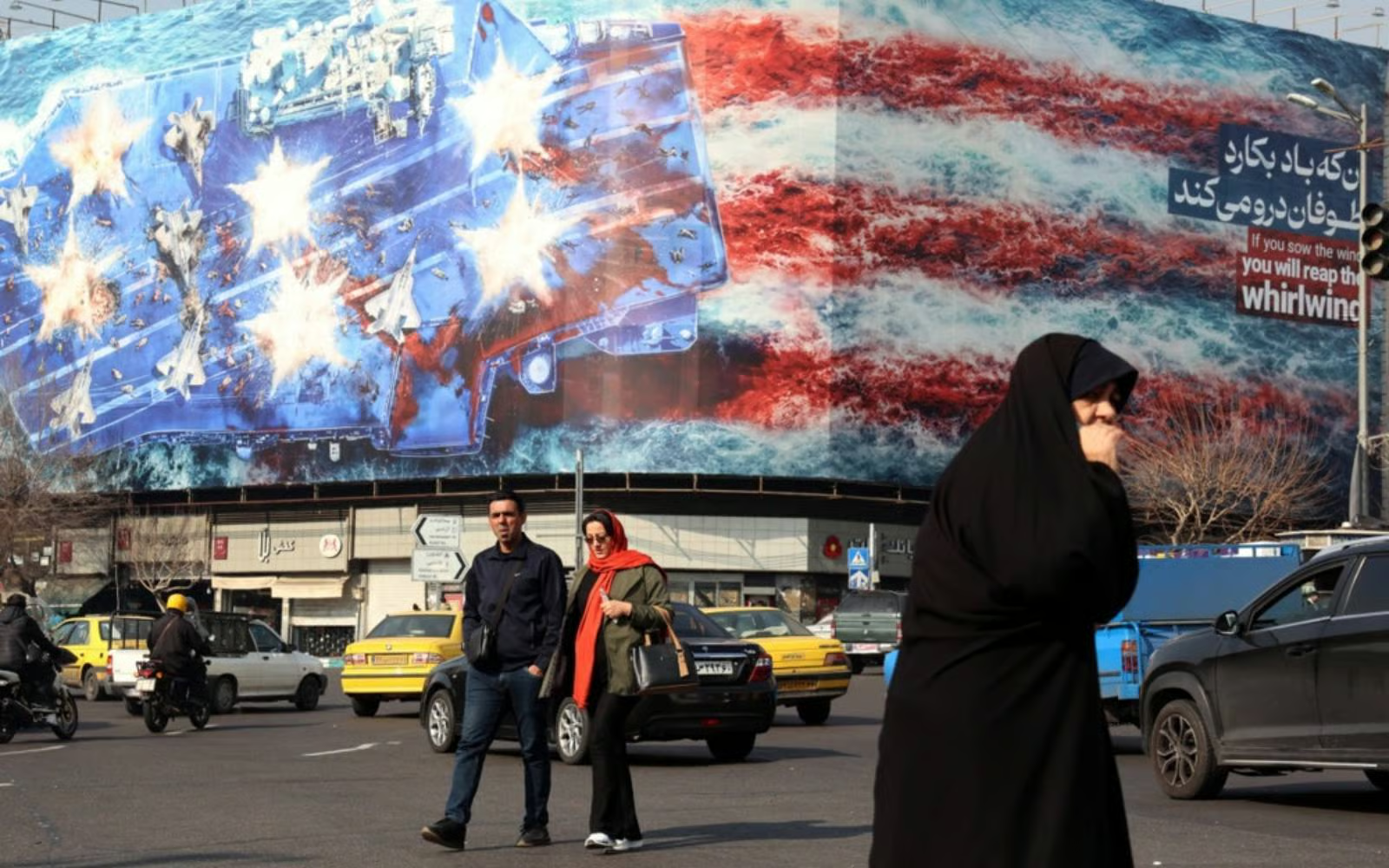
The United States and Iran are continuing to ratchet up tensions between both countries following an Iranian warning that they will respond “immediately and forcefully” to any military actions by the US. Iran is also keeping the door open for a diplomatic resolution regarding its nuclear programme.
On Wednesday, Iranian Foreign Minister Abbas Araghchi announced that the Iranian armed forces are “fully prepared and have their fingers on the trigger” and will respond to any attacks against Iran’s territory by land, air or sea. He also reiterated Iran’s willingness to negotiate a “fair and equitable” agreement relating to its nuclear program.
Trump’s comments came shortly after he announced that the United States had already sent a “massive armada” to Iran; he referred to the naval task force as “larger than any other that the United States has sent as part of our pressure campaign against the leader of Venezuela”.
After posting about Iran on his Truth Social page, Trump said, “I am sure Iran will come to the table (and) we want A DEAL WITH (NO) NUCLEAR WEAPONS – If negotiation does not work, U.S. Fleet is ready, willing & able to act swiftness & VIOLENTLY.”
Human rights and nuclear focus
Concerns regarding human rights abuses and nuclear weapons have become more focused in recent weeks within the U.S. following unrest across the country. The U.S. Human Rights Activists News Agency (HRANA) estimates that over 6,300 individuals have died as a result of protests, while the Norway-based organization Iran Human Rights stated that the actual number may exceed 25,000.
In light of Trump’s earlier suggestions of possible military intervention in response to Iranian government suppression of protests, his comments increasingly reflected a growing concern about Iran continuing its pursuit of nuclear weapons and reinforced the possibility of military intervention.
Despite Iran being economically weakened due to international sanctions, civil unrest, and continued military strikes from Israel and the U.S., they continue to have many options available to retaliate against foreign attacks.
ALSO READ: India EU Car Tariffs: Luxury Vehicle Duties Slashed Under Trade Deal
How Iran could strike back
Iran has a large arsenal of surface-to-surface missiles (ballistic) capable of reaching the United States bases in the Middle East and the state of Israel. Their Shahed drones have proven successful in other conflicts, and they have a wide-ranging missile arsenal with missiles ranging from short- to medium-range.
Iran could use additional support from its regional allies, such as Hezbollah in Lebanon, Iraqi militias like Kataeb Hezbollah, and Yemen’s Houthi movement. Although these allies have limitations of their own, a coordinated proxy attack could stretch US and Israeli defenses thin.
Iran may also be capable of economic warfare against the global community through its position in global energy markets. Tehran sits near the Strait of Hormuz, a narrow waterway through which about 20% of the world’s oil and a significant share of its natural gas passes.
Any disruption (e.g., naval mines, drones, or fast-attack boats) in this waterway will send oil prices into a tailspin, pushing the world into a possible recession. Iran has previously employed these tactics, most notably during the “Tanker War” of the 1980s.
Iran’s message has thus far been one of deterrence and an openness to diplomacy. Conversely, Trump seems to be following the path of forcing a concession through maximum pressure.
The dangers that we now face are very real; one miscalculation can turn a warning into a war that has effects well beyond Tehran and Washington.
FOR MORE: https://civiclens.in/category/international-news/
About the Author


