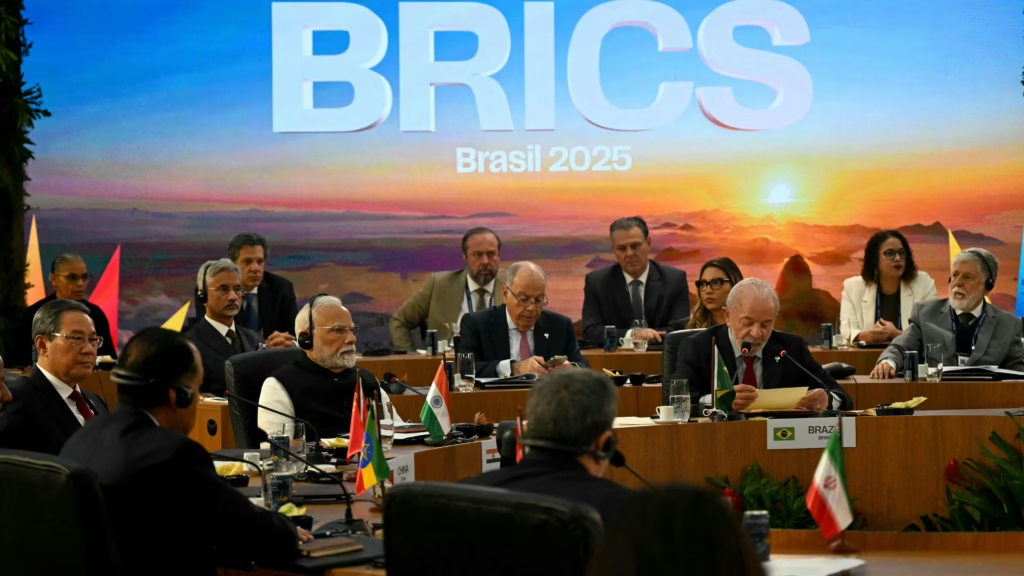
The BRICS Bridge payment system is emerging as a new digital platform designed to reduce dependence on the US dollar and challenge Western-controlled financial networks like SWIFT. Developed by Brazil, Russia, India, China, and South Africa, the system aims to support cross-border payments in local currencies and strengthen financial independence among member states.
While BRICS is still working to establish the BRICS Bridge Payment System, its development reflects the growing desire of the member states of Brazil, Russia, India, China, and South Africa to achieve greater autonomy with respect to their financial dealings/exchange and strengthen their trade partnerships through the use of local currencies.
The Need for Alternatives to SWIFT
For more than 30 years, the SWIFT network has been the principal means of transmitting communications between commercial and investment banks worldwide. SWIFT does not facilitate actual money transactions; rather, SWIFT provides a means through which banks can send secure payment instructions to other banks located throughout the world. Banks send their payment instructions to other banks via SWIFT using the networks of their respective correspondent accounts.
There is an overall view that while the system may work well functionally, it has a significant Western influence. For example, both the United States and its allies have utilized SWIFT as a method of pursuing sanctions, most notably against Russia, thus raising numerous concerns for all BRICS countries regarding financial surveillance and susceptibility of being politically pressured.
For example, whenever a Chinese company purchases soybeans from Brazil via SWIFT, the entire transaction is available to Western authorities. While this facilitates reporting and compliance, it creates limitations surrounding the trader’s ability to maintain strategic financial independence.
Additionally, a key area of change is the recent agreement signed by both China and Brazil to use their respective currencies (RMB and BRL) to settle trade rather than U.S. Dollars (USD). This allows for significant savings on transaction fees, eliminates much of the foreign exchange risk, and creates further depth to the bilateral financial relationship.
The recent agreement reflects one of the more prominent BRICS strategies for promoting local currency trade, while also reducing dependence on the USD for conducting international business.
How BRICS Bridge Works
BRICS Bridge is intended to serve as a digital platform intended for cross-border payment processing between members of the BRICS organization. Unlike SWIFT, its intended design is to integrate messaging and settlement functionality using decentralized technology elements.
Key features include:
– Payments using national currencies without relying on USD.
– Less reliance on the United States dollar (‘USD’).
– Design, development and implementation of a Blockchain and Distributed Ledger Technology
– Ability to transact electronically peer-to-peer.
– Low transaction costs.
– National independent nodes for each of the participating countries.
The system runs off the Blockchain node (computer) to provide and verify the transaction between participants and keep the transaction data local to the participating nation(s). This allows low third-party oversight of transaction data.
To simplify it, the BRICS Bridge intends to replace SWIFT by functioning as a self-contained digital highway for both message and money transfer.
ALSO READ: Gold Silver Price Crash: What Triggered the Sudden Market Turmoil
Political and Economic Implications.
The implementation of the BRICS Bridge has not gone without notice to the United States’. President Donald Trump warned previously of punitive tariffs to be levied against BRIC Nations (India, China, Brazil, Russia, South Africa) if they create an alternative to the United States dollar (‘USD’). Despite these warnings the BRIC Nations continue to push forward expanding the use of Local Currency Settlements and Bi-Lateral Trade agreements. This indicates that Economic Diversification is becoming more important than Political Pressure.
Experts warn that BRICS Bridge is currently in its early stages and it is unreasonable to imply that it will quickly become a viable alternative to the Society for Worldwide Interbank Financial Telecommunications (SWIFT). Thousands of banks use SWIFT daily as an established global financial service.
While the growing popularity of BRICS Bridge (along with the establishment of currency swap agreements and regional payment systems), illustrates that there is a gradual but significant movement toward a multipolar financial system; if successful, the transition away from SWIFT could fundamentally change how emerging markets trade, invest and manage their respective financial risks over the next several decades.
FOR MORE: https://civiclens.in/category/category-business-economy/
About the Author