The end of US Russia nuclear restraint marks a decisive shift in global security calculations. Today, the world has awakened to a deafening historic break. There is no physical demonstration of this change, just a quiet termination of a treaty, but the implications of this termination will be felt everywhere. Decades-long restraint between the United States and Russia has ended without any missiles being fired, yet the situation has become more dangerous. Both Washington and Moscow now find themselves with fewer nuclear limits than when the treaty was signed over twenty-five years ago. Uncertainty about how stable the previously fragile global balances will be is now spreading throughout the world.
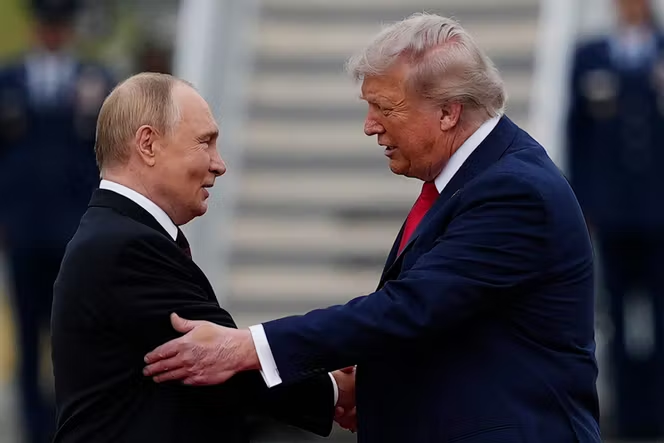
This treaty has existed for many years as a ceiling for destructive nuclear weapons, and now the ceiling has been removed from the treaty in an environment of war and distrust. The leaders of both nations have given mixed signals to the world, as opposed to any assurances that their use of nuclear weapons will remain stable. As a result, predictability regarding nuclear governance has been replaced with an increased level of anxiety regarding the potential for miscalculating the use of nuclear weapons compared with intentional aggression by both nations.
Why the Treaty’s Expiration Carries Greater Risk Today
This timing has made this treaty’s expiration that much more significant, given the existing wars, existing rivalries, and the continued decline of diplomacy between the two nations over the last few years. Therefore, the time for nuclear giants with no legal restrictions is an unavoidable question and one that will most likely shape global security through the next generations. Thus, there is now an urgent need to understand the gravity of this treaty’s expiration so that a cool-headed analysis can be undertaken, rather than an emotional reaction, so that the relative risks of the nuclear situation can be fully comprehended.
What the New Start treaty actually restrained
The New START Treaty restricted deployed strategic nuclear warheads to a maximum of 1,550 for each side. It also established a system of transparency and inspections that allowed for regular monitoring of missile movements and different compliance measures to be put in place so that mistrust was largely mitigated by verification mechanisms. The treaty was signed in 2010 and represented a period of cooperation during the post-Cold War era.
President Biden later extended this treaty until this year; however, the growing tensions over Ukraine have undermined cooperation. Consequently, extension negotiations stalled, and the respective sides have missed multiple deadlines for renewal. Both states now have no legally mandated limits on the deployment of strategic nuclear warheads. As such, there are fewer political constraints on the production decisions of strategic nuclear warheads than there were under the previous New START treaty. The shift in the arms control regime has raised concerns for arms control experts around the world.
Why global leaders fear the collapse of US–Russia nuclear restraint
Antonio Guterres called it a “serious moment”.
“For the first time in more than half a century, we face a world without any binding limits on the strategic nuclear arsenals of … the two states that possess the overwhelming majority of the global stockpile of nuclear weapons,” he stated. He warned that the risks of the use of nuclear weapons have reached record highs over the last several decades.
Similarly, Pope Leo XIV called on both sides to exercise restraint. Russia and the US may produce more than 80% of global nuclear armaments. As such, their decisions then directly affect global nuclear standards. Also of concern is the deterioration of the nuclear non-proliferation treaty (NPT), which potentially leads many non-nuclear states to question disarmament pledges made to them in the past.
Does this open a new arms race?
Both countries are quietly improving their nuclear arsenal. Russia has recently tested new systems for delivering nuclear weapons. In the meantime, Trump has made repeated statements about arms-control limits, including, “If it expires, it expires.” The increasing size of China’s nuclear stockpile is making any future nuclear-arms negotiations much more complicated than they are currently. However, even though China’s nuclear stockpile is very small compared to both the USA and Russia, the ongoing debates about whether to include China in any future agreements are delaying urgently needed diplomatic progress. Instability has now replaced the rules-based restraint on nuclear weapons, and any new negotiations will likely occur under pressure in the future. In the meantime, the world is entering a more dangerous period of nuclear activity. Without renewed diplomacy, the collapse of US Russia nuclear restraint risks reshaping global nuclear stability for generations.
For more- https://civiclens.in/category/international-news/
About the Author


