India counterterrorism policy represents a strategic shift as authorities respond to increasingly complex and technology-driven security threats.
India created an innovative counterterrorism plan because of increased fears for security. This came after many years of changing and increasingly complex threats. At first, officials saw urgency based on changes in technology. Over time, however, terrorist networks grew outside of the battlefield. The Internet also allowed for covert planning and quiet coordination. As a result, policymakers began to identify gaps in their security response. This framework provided some degree of certainty after many years of fragmentation within the institutions.
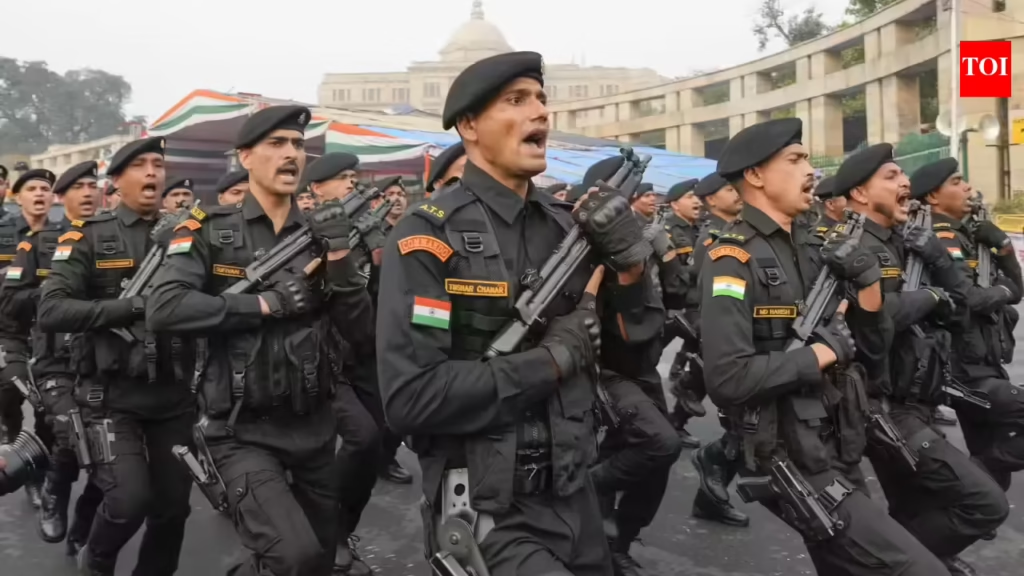
Additionally, recently occurring events made people very anxious about unseen, networked violence. Therefore, the focus of the authorities became to prevent terrorist acts and not react to them. Furthermore, the new policy was based on lessons learned from failures that occurred in the past and also recognised the limitations of strategies that were focused only on the use of force. Consequently, preparedness was created as an ongoing national responsibility. Ultimately, there was much interest in the extent to which governmental institutions would change in response to these challenges.
How PRAHAAR defines threats facing India under India counterterrorism policy
The Indian Union Home Ministry released the PRAHAAR document on Monday, which sets out India’s first cohesive strategy for counter-terrorism. This is essential since the report stated India has been “on the frontline in the fight against terrorism for decades.” Also importantly, it clarifies any links between terrorism and “any religion, caste or nationality”, as well as reiterating the ongoing challenges from cross-border sponsored terrorism. Furthermore, there are significant threats posed to India by both criminal hackers and nation-states. In addition, the framework identifies threats from land, air, and sea, together with an emphasis on protecting critical national infrastructure sectors of power, transport, defence, and space.
The document identifies large international terrorist groups like Al-Qaeda and ISIS, as well as warning of sleeper cells and foreign-based extremist groups. The handlers of these terrorist groups increasingly use drones to assist them with logistics for committing acts of terror. Furthermore, they are using encrypted communications, dark web-based platforms, and cryptocurrency wallets as the primary means to facilitate and support their criminal activities. The policy notes that cyber attacks will continue to represent a growing risk to the national interest of India, while additionally identifying CBRNED threats as continuous disruptions to operational success.
What the policy proposes for prevention and response
This framework encourages intelligence-led and preventative national counter-terrorism responses. The outcome will be improved coordination of agencies through dynamic information sharing. Local police will continue to act as first responders in the case of a terrorist incident. The National Security Guard will be deployed at the time of a major national crisis. The National Investigation Agency will coordinate all investigations into terrorism on a national level. To help expedite investigations, early legal interaction is stressed in the policy.
Additionally, there will be a uniform nationwide anti-terrorist structure in all states of India. Also, community and religious leaders are included in the de-radicalisation programmes. Youth will be included to address the social conditions that enable organisations to recruit extremists. There will also be provisions to monitor prisons to help prevent radicalising vulnerable prisoners. International co-operation will serve as the foundation for responding to transnational terrorism. Ultimately, the purpose of this strategy is to deny terrorists a means of accessing funding and a place of sanctuary.
For more- https://civiclens.in/category/national-news-civiclens-in/
About the Author


