India and Israel reached a high-profile diplomatic agreement earlier this week. More on that below, but first let’s examine what this visit represented beyond a bilateral engagement. Prime Minister Narendra Modi was welcomed in a region that has demonstrated volatility, resulting in heightened expectations of outcomes and commitments from both parties. Early indications suggested that there may be increased strategic alignment/merger as leaders emphasised their historical confidence in long-standing cooperative ties between these two countries.The India-Israel partnership now reflects a broader convergence of security priorities, economic interests, and regional diplomacy.
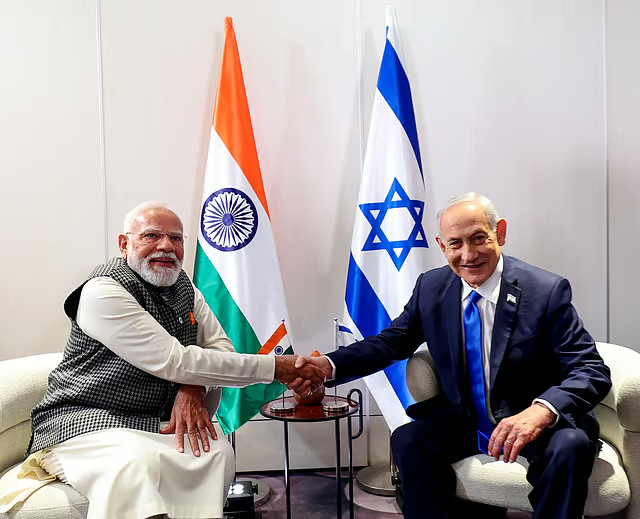
The objectives of the discussions conducted between the leaders spanned three areas of security, technology, and economics. In addition to these discussions having symbolic representation, and thus providing policy direction, this visit also framed India’s future- oriented relationship with Israel while simultaneously testing India’s ability to play a balancing act in West Asia. As such, there was much regional attention placed on the results achieved through this visit.
How agreements and partnerships reshaped bilateral ties under the India-Israel partnership
The two Prime Ministers elevated the relationship between their countries to a “special strategic partnership”, signing several Memoranda of Understanding (MOUs) in important economic sectors, and further cooperation in AI, cybersecurity, educational, and energy fields. Modi indicated that a commitment has been made to the use of UPI in Israel. There is also a firm commitment between both sides for increased cooperation in defence.
They harmonised their defence industry cooperation through agreements on joint development of new defence technologies and joint production of other defence things. Netanyahu stated that a government-to-government meeting will take place in the future. Modi has pledged full support for the Gaza Peace Initiative, stating, “Humanity must never become a victim of conflict.” He further stated that “The Gaza Peace Plan has created a pathway toward peace.” The two leaders highlighted the strong alignment they have with counter-terrorism efforts.
Why trade, UPI, and FTA talks stood out
That meeting renewed the focus on better working together on economic partnerships; through that meeting, India and Israel were able to establish a shared commitment towards making new progress on Free Trade Agreement (FTA) negotiations; India’s Prime Minister, Modi, said, “We will work to conclude a mutually beneficial free trade agreement.” To follow-up this meeting, officials indicated that they will be speaking again very soon regarding the FTA negotiations. The volume of merchandise trade currently stands at $3.62 billion; leaders of both countries are seeking to reverse the decline in trade that has occurred between the two countries.
The deployment of a UPI will help improve the transfer of money; that agreement between the NPCI International and MASAV of Israel. Officials anticipate that it will promote more effective transfer of remittances and payment services; in addition, the parties created a new Financial Dialogue Platform. Through this visit, India and Israel expanded the opportunity for Indian workers to work in Israel from 10,000 to 50,000. Overall, the visit gave both countries greater strategic depth with concrete accomplishments.
For more-https://civiclens.in/category/national-news-civiclens-in/
About the Author


