The war in Iran increased the number of attacks occurring in Gulf State nations. Iran’s military capabilities of missiles/drones were utilized in multiple countries throughout the region; these attacks occurred as a result of joint military operations performed by both the U.S. military and Israel within Iranian territory. As such, Gulf nation-state governments reported numerous explosions and missile interceptions. Iran’s Revolutionary Guard announced large-scale retaliatory operations against former U.S. and/or Israeli military targets; in statements, the Revolutionary Guard stated that “All Israeli and US military targets…struck.”
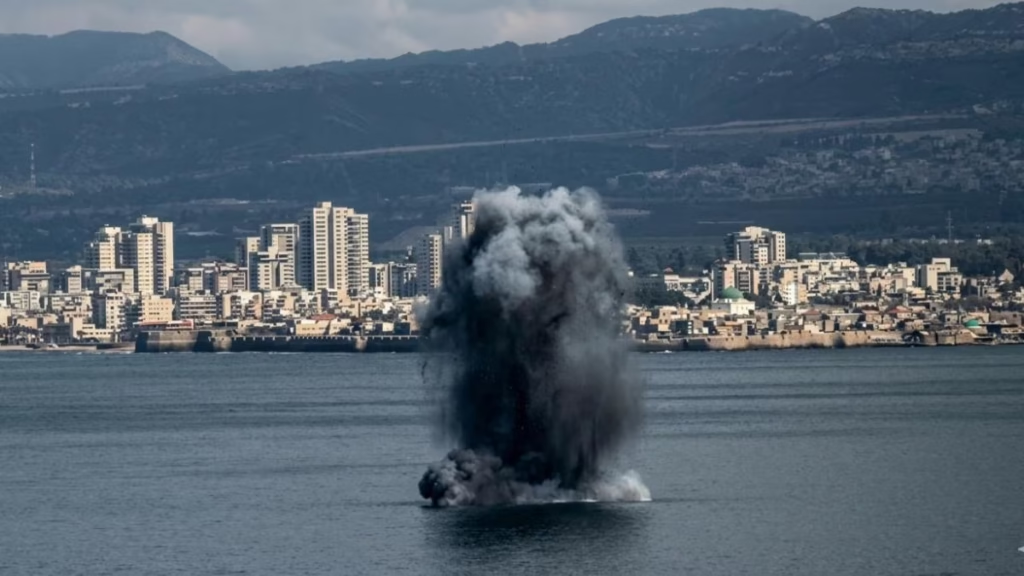
U.S. military infrastructure in the Gulf nation-states was also targeted. In the United Arab Emirates, an air assault occurred that involved major explosions; as explosions occurred over Abu Dhabi, UAE air defence systems intercepted many incoming missiles. However, parts of the missiles did land in residential areas, which resulted in one civilian casualty in the Emirate of Abu Dhabi. Additionally, Dubai’s major business districts were chaotic as a result of the ongoing air strikes across the UAE and the different nations that comprise the Gulf region. Various Gulf State government entities immediately closed airspace to commercial aircraft for safety/security reasons.
Dubai attacks signal a shift in the Gulf missile attacks
Historically speaking, Dubai represented a neutral position regarding regional conflict or crisis. However, from the latest attacks, that image has been compromised. Iranian missiles hit various areas in the UAE, including near Dubai International Airport, as well as places around Palm Jumeirah, where there was a fire visible from the Fairmont The Palm complex. Witnesses described explosions followed by attempts to intercept the missiles with missiles. One witness said she heard “a loud bang,” and then saw “a big puff of black smoke.” At the same time, Iran fired missiles at Bahrain, and like Qatar, missiles were fired at the al-Udeid air base. Additionally, drones have been stopped by Kuwait as they approached their airport. So the conflict has now rapidly expanded into many of the capitals of the Gulf region.
Escalation raises risks for India and global trade
Simultaneously, global economic stability is at risk from the ongoing crisis. Analysts anticipate serious disruptions to maritime trade. Shipping alerts have been issued near the Strait of Hormuz. Approximately 20% of the world’s oil passes through there. Therefore, energy markets are concerned about potential supply disruptions. Several air routes in the Gulf region have been closed, disrupting international travel. Injuries and some minor structural damage were reported at Dubai’s airport as a result of this disruption.
The UAE government issued a statement condemning this attack. They call it an “unmitigated attack” on their sovereignty and national security. The crisis will also affect millions of foreign workers across the Gulf. Nearly 8 million people from India currently reside in the Gulf States. Thus, Indian embassies have issued safety alerts for their citizens who may be affected by the crisis. All governments around the world are currently monitoring and assessing how the crisis will impact their economies and what humanitarian assistance may be required as a result of the crisis. Analysts warn that continued Gulf missile attacks could transform the regional confrontation into a broader economic and security crisis.
For more- https://civiclens.in/category/international-news/
About the Author


1 thought on “Gulf Missile Attacks and the End of Regional Neutrality”