A Historic Moment at the UN
Syrian President Ahmed al-Sharaa made history on September 24, 2025, becoming the first Syrian president in nearly six decades to address the United Nations General Assembly (UNGA). His speech marked Syria’s return to diplomacy and positioned him as a pivotal figure in Middle Eastern politics.
Al-Sharaa’s visit occurred less than a year since he removed Bashar al-Assad in December 2024 and brought an end to the Assad regime’s 50-year stay in power. New York hosted him, where he met with U.S. Secretary of State Marco Rubio as well as called again for Washington to remove sanctions under the 2019 Caesar Act.
From Abu Mohammad al-Julani to Ahmed al-Sharaa
Before assuming the presidency, the world knew him by another name: Abu Mohammad al-Julani. Born in Riyadh in 1982 to Syrian nationals of the Golan Heights, before he started identifying himself with jihadist movements in the early 2000s, he grew up. He then worked aggressively with al-Qaeda in Iraq amid the American invasion.
Detained by American troops in 2006, he was detained for five years before appearing in Syria once more as the Arab Spring uprisings of 2011 erupted.
In 2012, Julani established the al-Nusra Front, which is among the most influential rebel groups in the Syrian civil war. He was designated as a global terrorist by America, and he once had a $10 million price on his head.
By 2016, however, he broke publicly with al-Qaeda and rebranded his own group Hay’at Tahrir al-Sham (HTS) as the Syrian nationalist movement dedicated to local rather than global jihad causes. Julani also acquired a new name — Ahmed al-Sharaa.

The Downfall of Assad and Emergence of a New Leader
HTS in January 2025 staged a surprise coup, overthrowing Assad’s regime. Al-Sharaa was proclaimed transitional president shortly afterwards, backed by the Gulf and Turkey.
Saudi Arabia and Turkey and Qatar moved fast to accept his premiership as a Sunni counterweight to Iranian domination of Syria. The transitional new constitution, adopted in March 2025, granted broad powers to his presidency and established a technocrat cabinet as a transition.
Meeting Trump: A Symbolic Pivot
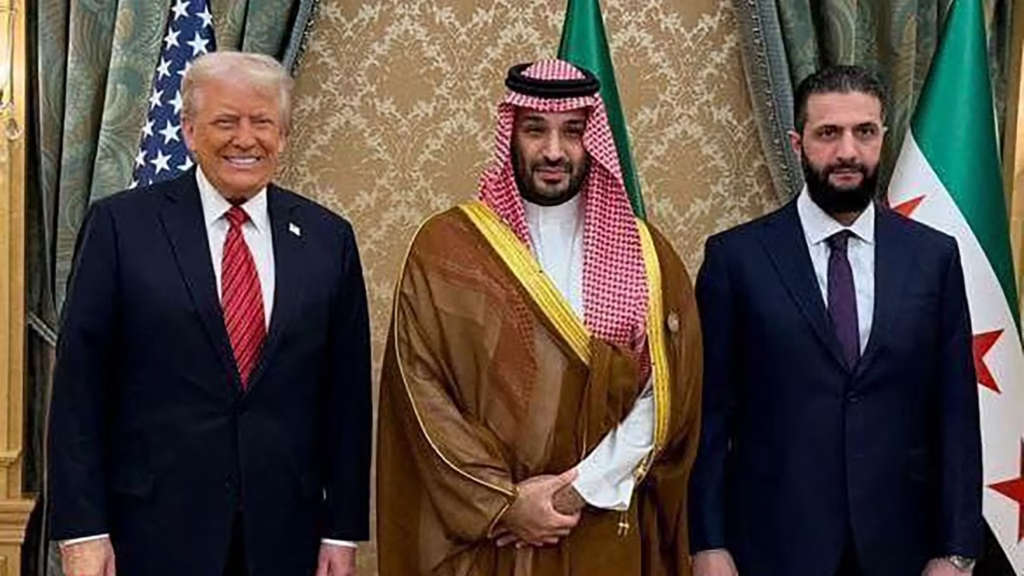
Earlier this year in 2025, al-Sharaa met with American President Donald Trump in Riyadh — the first face-to-face encounter between Syrian and U.S. leaders in 25 years. Trump welcomed joint him as an “attractive, tough guy” with a “very strong past,” a box office about-face in U.S. policy.
During the meeting, Trump vowed to lift sanctions and called on al-Sharaa to:
Expel foreign militants from Syria.
Take over Islamic State captives in Kurdish hands.
Consider diplomatic recognition by Israel.
The summit was welcomed by State Saudi Crown Prince Mohammed bin Salman, who had characterized it as a turning point, an “alleviating Syrian suffering” moment.
Domestic Jubilation, Regional Concern
In Syria, the Trump–Sharaa summit launched nationwide celebrations. Protesters took to the streets of Damascus, brandishing flags and firing fireworks, as state media declared an end to “economic strangulation.”
But not all regional actors were reassured. Israel was most cynical of Sharaa’s hard-line past and cautioned Washington that sanction relaxation would provide terrorist forces with a boost. October 7, 2023 Hamas attack was only one of such occurrences cited by Israeli authorities as to whether Syria under the leadership of Sharaa could be trusted to maintain its borders free from terrorism.
The First UN Speech in 60 Years
Inside the UN, al-Sharaa presented himself not as a hard man but as a statesman. He stated:
“This is Syria coming back to the international community after decades of agony and marginalization.”
He implored leaders globally to lift sanctions, contending that they inhibit reconstruction and punish ordinary Syrians. The address was symbolic and deliberate, putting Syria on the world agenda of players to be accounted for now.
What His Rise Awaits of Geopolitics
Al-Sharaa’s transformation is compelling governments to rethink their approach.
For Washington, taking him in and negotiating with him is a risk: stability at the price of legitimizing an former jihadist.
To the Gulf, his presidency is a victory in the war against Iranian expansion.
For Israel, it is a cause for concern regarding future security.
For ordinary Syrians, it gives them a chance of economic respite after war and sanctions.
From Pariah to President
Ahmed al-Sharaa’s journey from a designated terrorist to Syrian president speaking before the UN illustrates the fluidity of Middle Eastern politics. His background is suspect, but his future is certain: he speaks for Syria’s new regime.
Whether this is the way to actual stability or merely rebranded authoritarianism, only time will reveal. What is clear, however, is that Syria has re-emerged onto the world scene — on the arm of one of the most unlikely leaders of the 21st century.
FOR MORE : https://civiclens.in/category/international-news/
About the Author