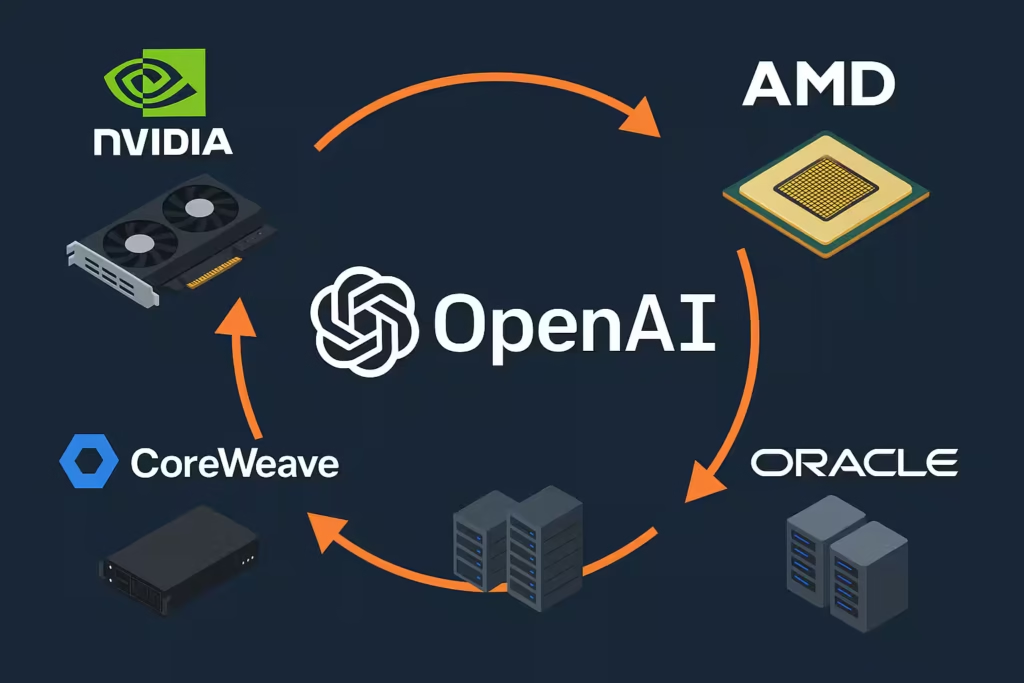
The AI circular economy is reshaping technology investments in 2025. Money, hardware, and cloud services are exchanged hands daily between multiple participants, primarily Nvidia and its contract business partners, including OpenAI, Microsoft, Oracle, AMD, and CoreWeave. In summary, duty demand, skeptics began to ask if any appreciable value associated with AI companies was indicative of authentic demand or was simply self-perpetuated exchange contracts and embedded circular economies.
Nvidia Dominates the AI Circular Economy
There is little doubt that the AI Chips propelling today’s groundbreaking AI apps, including ChatGPT, are made by Nvidia. The company’s market capitalization exceeded 5 trillion dollars in 2025. Nvidia’s position as the leader drew in prospects, vendors, and investors, leading to tightly bound partnerships across the technology ecosystem.
In September 2025, Nvidia committed $100 billion to OpenAI for the huge growth of the capacity of its AI data centers. OpenAI proceeded to buy millions of Nvidia chips, ensuring Nvidia a revenue stream for the foreseeable future. OpenAI also had cash to quickly start its expansion. Detractors called it a circular deal but did produce asset wealth – in the form of hardware chips and data center infrastructures – for both companies.
OpenAI Expands Its Cloud Business
Facilitated by this, OpenAI soon proceeded to sign a 5-year, $300 billion deal with Oracle called Project Stargate. Oracle has agreed to add 4.5 gigawatts of Prudential technology data center capacity by 2027. Oracle also agreed to purchase $40 billion of premium Nvidia chips to support its infrastructure.
This triangle created a chain reaction of economic value and financial transactions. Oracle’s stock increased by 36%. Nvidia similarly increased by 4%. All stakeholders benefited financially from the deals. These financial deals allowed their business to solidify its computing capacity.
AMD Partnership Strengthens the AI Circular Economy
Conversely, OpenAI formed a partnership with AMD to reduce its reliance on Nvidia. OpenAI is committed to utilizing six gigawatts of AMD Instinct GPUs. OpenAI received warrants for about 10% equity for this deal, which would begin to vest based on its utilization of AMD GPUs.
This arrangement would guarantee AMD a significant client while also improving OpenAI’s own architecture. According to Dr. Lisa Su, AMD’s CEO, “it was a total win-win, trying to advance the AI infrastructure and shareholder value.
CoreWeave and an Intermediary in Cloud
Cloud providers, such as CoreWeave, are important players in this circular economy. OpenAI had contracts for $22.4 billion for GPU services. Nvidia was able to counterfund those in equity and also pre-purchased about $6.3 billion in CoreWeave.
Those pre-purchases and guarantees allowed CoreWeave to grow quickly and to purchase more Nvidia GPUs. Nvidia was essentially financing both the supplier (CoreWeave) and the customer (OpenAI), augmenting the circular ecosystem.
Microsoft’s Early Investments in the AI Circular Economy
Microsoft’s initial investments in OpenAI set forth the loop that exists today. Between 2019 and 2023, Microsoft invested approximately $11 billion for nearly a 50% stake in OpenAI in exchange for OpenAI essentially using Microsoft Azure to compute. By 2025, OpenAI will have diversified its partnerships with Oracle and CoreWeave, and Microsoft’s stake will indirectly profit from the growth in demand for hardware, as interest in Step 1 (OpenAI/ChatGPT) will have driven continued use of Azure. Microsoft’s actions will amount to a more passive type of public-private partnership by fueling an ever-engaging circular revenue structure that can recycle itself along its course.
The Role of Government Involvement in Shaping the Ecosystem
The U.S. CHIPS Act began the manifestation of public policy into injected semiconductor manufacturing, where the public sector provided Intel an equity investment of $8.9 billion and grants of $2.2 billion. Further, the United States Department of Commerce acquired hundreds of millions of shares in Intel. The public investment will fuel supply chain growth and provide an ecosystem to support AI chips. Restrictions on policy, such as restrictions on commerce with China, created a narrower inward loop of transactions amongst allied producer companies, and as demand grows, so too do circular transactions.
Risk and Implications
OpenAI plays an integral role in this expansive financial and operational ecosystem. OpenAI has established suppliers and a fragmentation of the infrastructure to enable industry-wide AI acceleration. However, systemic risk still exists. There are critics who posit that companies may eventually only see valuations reflect the increase in circular transactions in the absence of external net demand for their product. It is reminiscent of the cautionary tales of the dot-com boom.
Summary and Conclusion
At the end of the day, the AI boom of 2025 exemplifies the interplay between complex innovation within technical and service finance. A circular economy has formed amongst Terms, partners at Nvidia, and technology companies alike, which reinforces and is relevant to the emergence of growth and risk regarding supply chains. This circular economy has enabled secure supply chains, large-aggregate investments, and can support notable transactions in the tech sector if we can manage supply at each company and in supply chains and not allow an overreactiveness in outsized tech sector progression.
For more- https://civiclens.in/category/category-business-economy/
About the Author




1 thought on “AI Circular Economy Secrets: Nvidia, OpenAI, and the Money Loop”