The Bangladesh political unrest has intensified following the killing of a student leader and growing street violence under the caretaker government. Bangladesh has entered a period of increasing instability due to the assassination of a student leader named Sharif Osman Hadi. This violence showed the weakness of the current law and order situation, which is under a caretaker government. After people mobilised against the Awami League, the caretaker government led by Muhammad Yunus took power, at first promising election reforms and a quick transition to democracy, but they have been unable to keep their promises, creating uncertainty and frustration among the public. Additionally, there have been mob attacks against political workers from rival parties and against independent media outlets. While mobs have targeted Awami League supporters, they have also attacked those who did support them.
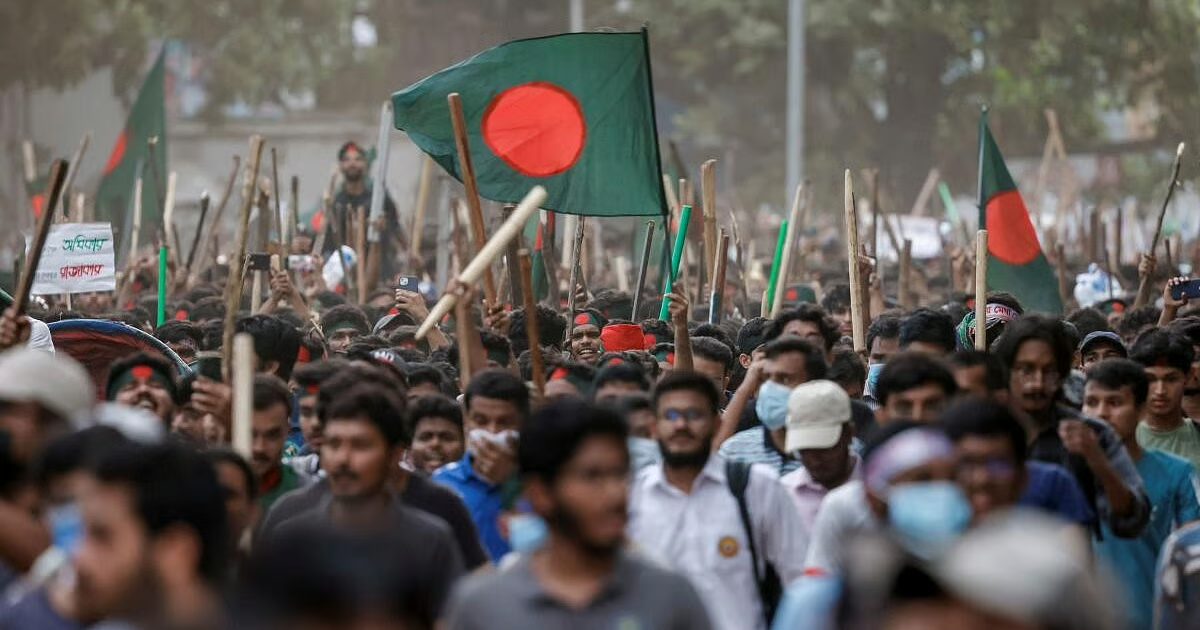
As such, trust in the transition to democracy has decreased rapidly over the past few months, and there is also a growing sentiment against India among radical student groups, who link India’s support of Bangladesh’s current situation. These radical student groups blame India for Bangladesh’s political crisis, and Islamist groups have been able to build on their message through sustained street mobilisation. This represents a challenge to Bangladesh’s secular foundation and the stability of the region. As such, Indian diplomats have adopted a cautious and watchful approach to diplomacy. Indian diplomats want to show restraint as they watch how the situation is evolving, especially due to their concerns regarding the potential for increased political polarisation within Bangladesh if an impulsive move is made regarding the situation.
Burial decision adds symbolic tension to Bangladesh political unrest
Following the burial of Sharif Osman Hadi at the University of Dhaka by authorities, the crisis deepened. Hadi has now been buried next to Kazi Nazrul Islam, who is considered the national poet of Bangladesh. Hadi’s burial came at the request of Yunus’ office and several student organizations, although his group stated that this was an act of family interest.
Many people have viewed this act as an attempt to change the political meaning of the burial. As evidence of this, thousands of people gathered in Dhaka to attend Hadi’s burial procession. Hadi’s growing symbolic power among radical supporters has contributed to his popularity as a figure in the radical movement.
Many critics argue that the way Hadi was buried has politicized our understanding of our historical and cultural legacy as a nation. In addition, several Islamic student organizations, including Jamaat Shibir, publicly supported Hadi’s burial as a revolutionary act against the current political system.
In contrast, many of Hadi’s opponents have warned that the symbolic associations attached to Hadi’s burial may further legitimize extremist narratives. As such, the current uncertainty regarding the February elections will make it more likely for violent extremists to gain traction and will create further challenges for political stability within Bangladesh. Therefore, India should be vigilant about potential cross-border security issues that may arise from this political situation.
Many experts believe that it is critical to maintain ongoing dialogue with all political actors within Bangladesh. In the event that credible elections are held, we may be able to establish political legitimacy once again. However, until this occurs, we are facing serious challenges to regional stability as a result of the unrest in Bangladesh.
For more- https://civiclens.in/category/international-news/
About the Author