Historic Turnout in Bihar 2025 Assembly Elections
The Bihar 2025 Assembly Elections Phase 1 saw a historic 64.66% voter turnout, marking the highest participation in the state’s electoral history. This figure exceeds the highest turnout figure of 62.57% witnessed in the 2000 Assembly elections and also exceeds that of the turnout percentage during the state at 64.6% in the 1998 Lok Sabha elections.
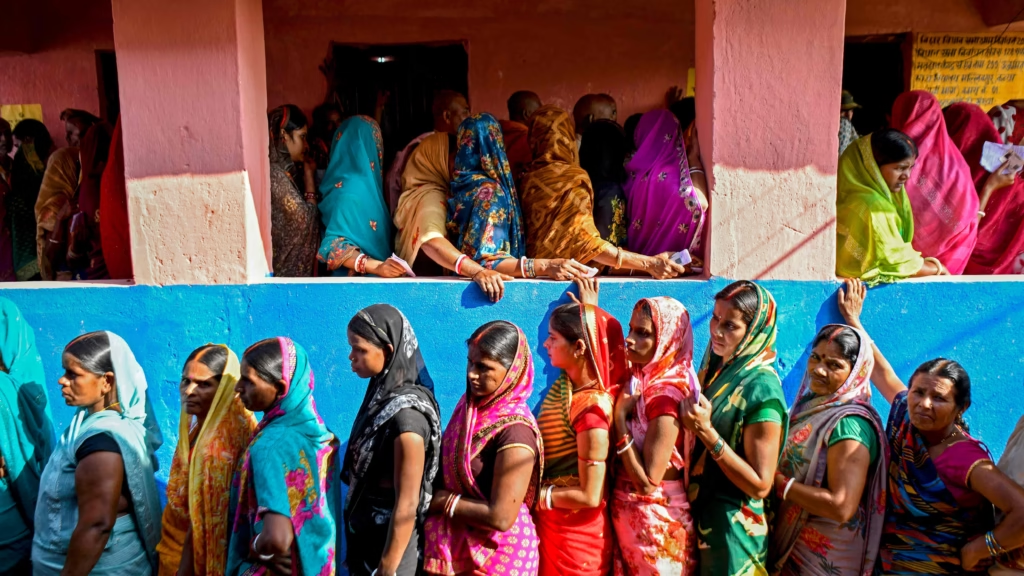
The importance of the turnout figure is further heightened simply because this figure is coming in the wake of what was a controversial voter list revision that resulted in 47 lakh names being removed. Opposition leaders alleged that the Election Commission was specifically targeting underserved communities. The overall voter base in the state declined from 7.89 crore to 7.42 crore.
Experts said the decline statistically raised the percentage of actual voters, and it is now difficult to compare to previous elections. One other fact about polling station turnout figures is that they indicate voters’ commitment to the elections, while the actual overall figure remains unknown. Chief Election Commissioner Gyanesh Kumar praised voters for going out to vote “in such large numbers” and thanked the election officials and staff for managing the process effectively.
For detailed voter turnout statistics, visit the official Election Commission of India – Voter Turnout Reports
Voting Proceeded Peacefully in 18 Districts
This first phase included voting in 121 Assembly constituencies in 18 districts. There were a total of 3.75 crore voters eligible to vote, and 45,341 polling booths were set up, mostly in rural areas.
Chief Electoral Officer Vinod Singh Gunjiyal said that polling opened at 7 AM and ran peacefully. By 6 PM, provisional numbers were indicating that 64.66 % percent of voters had returned to vote.
Election officials received a total of 143 complaints on the day of polling, all of which were attended to quickly. Begusarai had the highest turnout percentage, while Sheikhpura had the lowest turnout percentage.
For the first time, all polling booths in Bihar were streamed live to the Election Commission so that they could track polling in real time.
Incidents of Violence and Tense Moments
Even though both polling stations were uneventful for the voters, in different areas of the state, they faced incidents of violence.
In Lakhisarai, Deputy Chief Minister Vijay Kumar Sinha claimed that “RJD goons” attacked his convoy, adding that a number of voters were intimidated before the PM arrived. The Election Commission followed up with a request to the state apparatus for a report regarding the situation.
Separately, yet with threats, a band of unidentified pirates assaulted the cavalcade of CPI(ML) MLA Satyendra Yadav in Manjhi constituency, Saran district. The police on duty confirmed the MLA was safe.
Major Candidates and Stakes in the Election
Meanwhile, a number of significant political players were in action, including Tejashwi Yadav running from Raghopur, notable as the constituency of his parents, Lalu Prasad Yadav & Rabri Devi. The other major is Samrat Choudhary, Deputy CM and BJP state unit chief, running from Tarapur. The final player returned to the public eye, singer Maithili Thakur, running from Alinagar on a JD(U) ticket.
The Mahagathbandhan-RJD, being the strongest block of that coalition, was looking to be reinvigorated again in campaign mode from 2020. The JD(U) party was in power now with CM Nitish Kumar in charge, and the JD(U) party had not been favoured in terms of governance and development.
Is high voter turnout a sign that a change is coming?
Political analysts disagree on whether high voter turnout is a sign that a change is here.
Some analysts believe high voter turnout indicates some degree of anti-incumbency mentality. They will point to prior elections, such as the 2015 election, when increased voter turnout among voters contributed to the Grand Alliance’s shocking victory in the state, even with the opposition conducting a well-organized effort.
Other analysts urge caution regarding high voter turnout. Good turnout in both Madhya Pradesh and Chhattisgarh from 2003 to 2013 produced a national party that maintained its bureaucratic and political leadership; therefore, high voter turnout does not equate to change.
Second Phase of Bihar 2025 Assembly Elections: What to Expect
Polls for the second and final phase of elections are on November 11 for 122 Assembly constituencies, and the counting and declaration of results is on November 14.
Political commentators believe that thirty-three party leaders/observers support turnouts. The final product will show whether or not Bihar is shifting power, or restate the confidence in the present leaders.
In sum, the knock-up in turnout has addictively created excitement around the election and been a strong signal of an engaged electorate
For more- https://civiclens.in/category/national-news-civiclens-in/
About the Author