Canada-India reset efforts gained momentum as Mark Carney’s visit signalled a cautious reopening of diplomatic and economic channels after a bruising rupture. There was uncertainty about the reopening of relations between the two countries, which had suffered a bruising break. In both capitals, officials critically assessed all signals before making any political commitments. Diplomats worked quietly to rebuild those channels of communication while rhetoric was softened in public. Various pressures to do so created a pragmatic basis for engagement.
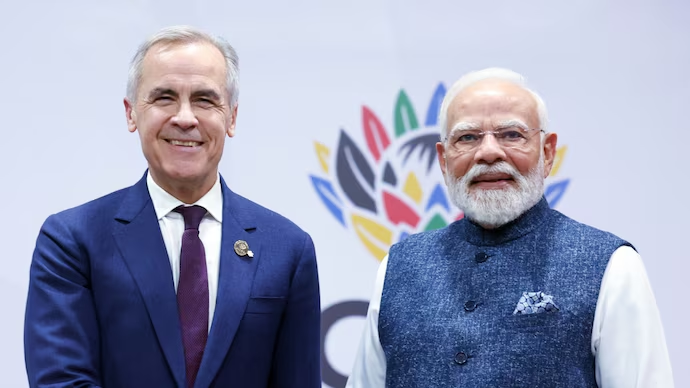
Trade dependence on Washington created incentive alignment between both parties. Energy security became a top priority for both parties. Business leaders were ready to be cautiously optimistic. Security concerns required a coordinated approach to messaging and sequencing. The trip began with a business purpose in Mumbai before transitioning into a political purpose in New Delhi. There was some urgency evident behind the measured execution of the interactions between the two parties. The global tariff environment significantly influenced all discussions.
What Canada seeks from a pragmatic reset in the Canada-India reset
Canada wants to diversify through trade based response to trade-driven policy by Mark Carney. Officials want to revive the long-stalled free trade negotiations. The Canadian government focuses on energy, technology, defence, and talent. There are Canadian companies that want access to markets and predictability regarding regulations.
Canadian leaders are emphasising de-risking (reducing risk) as opposed to decoupling (removing from) other countries. There will be no demonstratively symbolic stops on the itinerary to emphasize a commercial focus. There will be meetings with government officials and diplomatic representatives with business leaders and policy makers. Security discussions will continue in conjunction with economic discussions. The Sikh community will require continued engagement as part of ongoing engagement. Officials indicate there are less risk in conducting business with Canadians will have less risk, while courts will adjudicate cases regarding business. The approach is to create a balance between repair and assurance within Canada.
Why India views the visit as a win
New Delhi is anticipated to benefit from Narendra Modi’s increased determination to diversify. India is looking for dependable energy sources, even though it is experiencing pressure from tariffs. Uranium imports are aiding in India’s expansion of its civilian nuclear power generation capability. Using oil and gas as import items is expanding the overall energy mix. Working together on technologies will support industrial upgrades and modernization. Trade discussions are expected to have momentum after several years of slow progress. By resetting its diplomatic relationship with India, Canada reaffirmed India’s strong negotiating position.
Both countries discussed tariff issues with respect to each other’s exports. The middle-power logic that is common to both countries encourages cooperation beyond the United States. The pace of cooperation between the two countries is reflective of the major changes occurring in the world’s geopolitical landscape.
For more- https://civiclens.in/category/national-news-civiclens-in/
About the Author