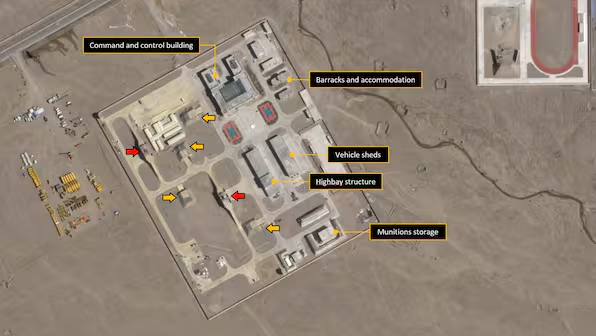
Fresh satellite images show that China is building a fresh air-defence facility close to Pangong Lake in Tibet, barely 110 km from one of the major points of friction of the 2020 India-China border conflict. The fresh development, visible in recent high-resolution shots, has raised security alarm in New Delhi as Beijing continues to beef up its military infrastructure along the Line of Actual Control (LAC).
Satellite Photos Uncover a Strategic Military Base
On the eastern shores of Pangong Lake, satellite imagery indicates massive construction under way there — command-and-control structures, barracks, motor sheds, radar sites, and ammunition dumps. According to analysts, the most dramatic feature unveiled is a series of covered missile launch bays thought to contain Transporter Erector Launcher (TEL) vehicles for mounting long-range HQ-9 surface-to-air missiles.
These bunkers seem to have sliding retractable roofs, enabling the missiles to be launched without putting the vehicles out in the open. This arrangement, analysts point out, provides better protection and cover from enemy detection or attack.
The layout of the site, initially discovered by AllSource Analysis (ASA), a US geo-intelligence company, who also detected an identically placed installation in Gar County, 65 km from the LAC — directly across from India’s upgraded Nyoma airbase.
Analysts Sound Warning on China’s Growing Military Network
Independent imagery from US space intelligence firm Vantor confirms the results. Their 29 September data indicate open panels over some of the missile shelters, potentially exposing launchers below.
These covered positions under ASA “enable the launchers to be protected while firing through hatches,” complicating detection of their movements. Such facilities, the agency said, “minimize detection threats and protects valuable assets from potential preemptive attacks.”
This design is consistent with military engineers’ understanding that it closely resembles other Chinese facilities constructed in the South China Sea, which indicates Beijing’s desire to duplicate successful military templates along vulnerable border areas.
A Pattern of Strategic Expansion
The initial construction activity around Pangong was spotted in July by geospatial analyst Damien Symon, but the existence of protected missile bays was established only later through imagery with high detail. Analysts have also found evidence of wired communication infrastructure that connects different parts of the HQ-9 system for command-and-control connectivity between launch units and radar sites.
Some sections of the complex continue to be built, but the extent and complexity indicate a permanent and high-cost military installation.
Why India Should Be Concerned
Analysts in New Delhi consider the upgrade to be another step in China’s overall plan to enhance air defense cover across the western half of the LAC. The HQ-9, which is approximately equivalent to the Russian S-300 system, can target aircraft and missiles at extended distances, providing China a qualitative edge in aerial surveillance and interception.
With India expanding its own forward bases — such as the operationalization of Nyoma advanced landing ground — the timing of this new Chinese base is a reaffirmation of an ongoing military game of chess in the Himalayas.
A Silent Power Play
Though Beijing has not said anything about the satellite data, the building is part of an overall trend of dual-use facilities — buildings that have both military and civilian purposes but are strategically placed near zones of conflict.
For India, the message is unmistakable: as border negotiations continue to be at a standstill, China is stealthily building up its defenses.
FOR MORE : https://civiclens.in/category/national-news-civiclens-in/
About the Author