Economic Survey growth outlook projects resilience in India’s economy while cautioning policymakers about structural fragilities and future global risks. At first glance, the Economic Survey (ES) presents reassurance and stability. The projection of GDP would suggest that the country can withstand the turmoil in the global economy. However, a closer reading of the ES indicates that there is caution underpinning the positive assumptions on which the measure is based. Evidence of emerging structural fragility is included as the ES frames growth against these developments.

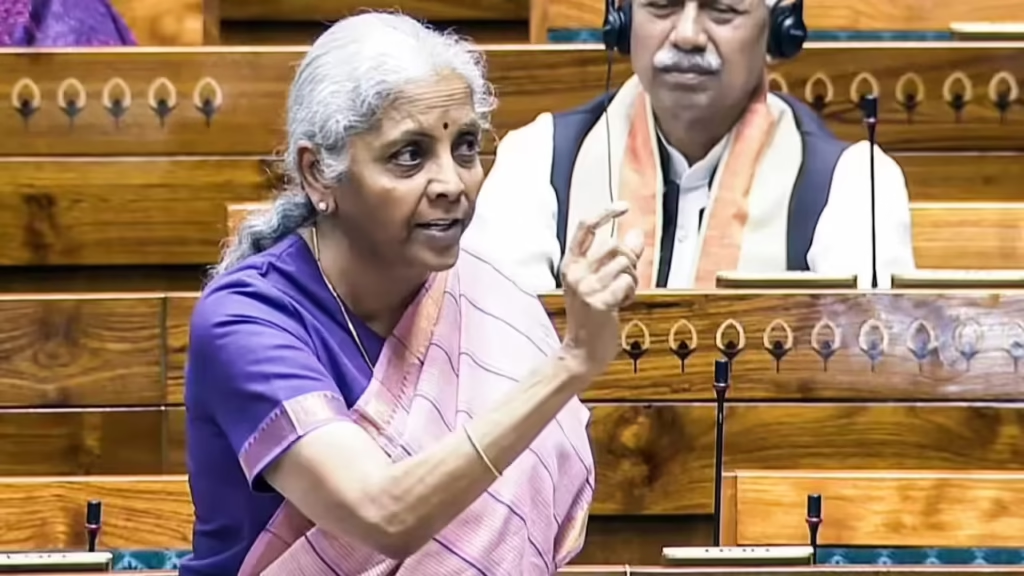
The submission of the ES occurred immediately before the Union Budget announcement. Consequently, both policymakers and markets would be carefully examining the ES for clues. The Finance Minister, Nirmala Sitharaman, presented the ES in Parliament, detailing the economic performance over the past year, which was quite challenging. The ES moved from an initial tone of confidence to one of confidence.
The ES projected that GDP growth could be in the range of 6.8% to 7.2%. This range is slightly lower than the current fiscal estimate. That said, officials highlighted the macroeconomic stability achieved and the recovery being experienced by both private and public sectors, particularly banks, and the positive trends relating to investment. The global situation continues to affect how domestic policies are evaluated and developed.
The ES highlighted that the stress level for the banking system had been decreasing; more specifically, banks appeared to have stronger balance sheets than in prior years, and are having less bad loans than in previous years. Investment activity in both manufacturing and infrastructure sectors was improving. The performance of the external sector was supported by the increased level of export and remittance activity. Inflation has, in most part, been contained.
The ES cautioned against becoming complacent as an economy. The ES stressed that the country should continue to be prepared for potential global and/or technological shocks.
Growth drivers reinforcing domestic momentum in the Economic Survey outlook
Initially, recovery in manufacturing led to an optimistic growth outlook. Survey’s results consistently supported increased levels of Manufacturing GVA. Improvements in infrastructure (expanding network of freight movement), aided by PLI Schemes, attracted large-scale private investment into manufacturing.
Foreign exchange reserves provided strong external buffers in addition to those aforementioned. As a result, these developments reinforced positive medium term growth expectations.
Structural risks shaping the road ahead
The Report also identified Technology Disruption as a potential threat to businesses. There have also been increasing skill gaps created by the era of AI and Technology. The CEA indicated that a strong manufacturing industry is essential to the stability of the country’s currency.
Income and income levels that continue to increase are now causing operational costs to also increase as we import more goods into the country and become reliant on processed goods from other countries. India must create an environment that builds economic reserves through the development of industrial strength.
The Report substantively strengthened the case for Swadeshi to be looked at through the lens of creating opportunity for India’s future through establishing global supply chains. The Report also warned about the risks of creating easy access to capital by way of global capital flow,s leading to a system that is unstable. Policymakers should look to balance between short-term economic development and long-term financial stability.
For more- https://civiclens.in/category/national-news-civiclens-in/
About the Author