The Gaza reconstruction initiative has returned to global focus as humanitarian and strategic concerns intensify amid continuing violence and fragile stability in the region. Global attention returned to a new multilateral diplomatic architecture as the humanitarian and strategic consequences of violence in Gaza persist. Washington sought to frame the moment in both a humanitarian and strategic way. New financial commitments to the initiative generated significant international interest almost immediately.
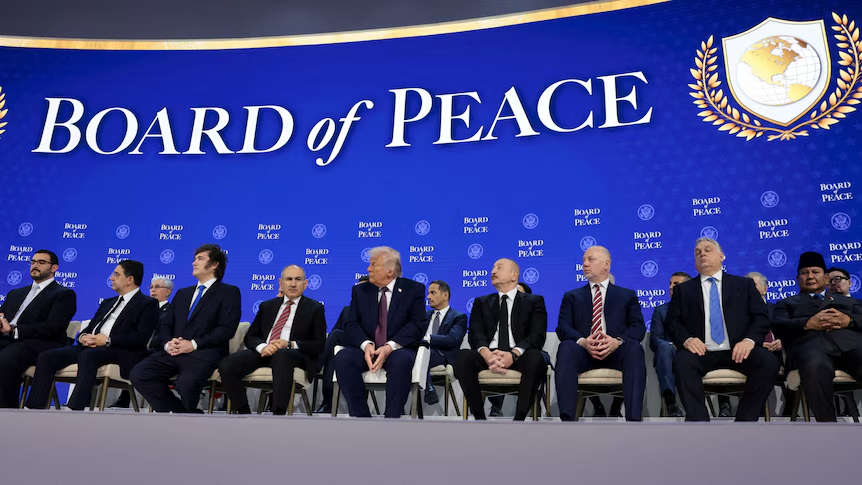
The announcement comes at a time when the fragile nature of stability in Gaza was at risk. Caution and skepticism were expressed by many in response to this initiative globally. The establishment of rebuilding efforts is now linked to the restructuring of security in Gaza. Rebuilding covers the future governance of Gaza, which has been raised as a question of debate.
Diplomatic narratives have been competing across multiple platforms throughout the globe. The announcement raised concerns about the viability of this initiative with regard to its implementation. The intersection of humanitarian urgency and the visible political ambition was evident in the announcement. The announcement was made after months of delay in pursuing a peace process between Israelis and Palestinians.
Civilian casualties continued despite the existence of declared ceasefire agreements. In this context, the funding pledges associated with this proposal could carry substantial symbolic value. What, if any, enforcement mechanisms are in place remains to be clarified. This proposal opens the door for renewed discussions related to external frameworks for peace.
Funding Commitments and the Expanding Mandate of the Gaza Reconstruction Initiative
Board of Peace members promised funds of more than $5 billion. Through public announcements, the amount was declared by Donald Trump. He described the organisation as having “unlimited potential.” Member countries made a commitment of financial support for Gaza reconstruction. Member countries will also be sending personnel for security stabilisation. According to Trump, the UN support was given to this effort. Support was also noted from the Security Council in aiding the project.
There are now more than 20 member countries that have pledged to participate and support the Borrowers’ Board. Some founding members are also regional leaders and governments. Members will look at how they can work together on areas of governance; others are concerned as to how governance will be developed through the work of the International Stabilization Force (ISF).
One of the key components of the ISF is to help develop the capacity of local Palestinian police forces through training by the ISF members. Funding will go toward providing humanitarian aid and rebuilding infrastructure. The Board of Peace will hold a meeting in Washington, D.C., very soon for all members to attend an executive meeting on February 19, 2020, which Donald Trump will chair.
Demilitarisation, Governance And Global Skepticism
The plan requires Hamas to completely disarm. Trump has repeated his requirement for “full and immediate disarmament of the military.” The proposal for Gaza outlines a government with a technocratic structure. The Board of Directors would implement transitional governance processes. Hamas’s defined red line creates significant obstacles to the implementation of the plan, according to critics.
Some partners have expressed concerns about the Authority’s ability to enforce the plan. Some argued against bypassing the Palestinian political consensus in reconstructing Gaza. Proponents argue that decisive leadership is necessary for successful reconstruction. Trump has attributed hostage releases to the work of the Board of Directors.
He has claimed that aid was delivered to Gaza at a “record” pace. Despite claims of ceasefire agreement violations, there are currently ongoing military operations throughout Gaza. Civilians have been killed by the recent airstrikes in Gaza. Funding is viewed as a means to implement the plan rather than a resolution. The plan is facing its first credibility test.
For more- https://civiclens.in/category/international-news/
About the Author


1 thought on “Gaza Reconstruction Initiative Highlights Tensions Between Aid and Security”