A global institution has an immense influence on power, but that influence is not visible. This is seen in the United Nations Security Council, which exhibits quiet power. The UNSC exemplifies an old version of the world in relation to what is currently governed today. India, in particular, realises and understands clearly the contradiction to this structure. India continues to engage actively in this structure. The UNSC is a governing body for important global decisions. It authorises military actions and sanctions globally. It also serves to mandate peacekeeping efforts in areas of conflict.
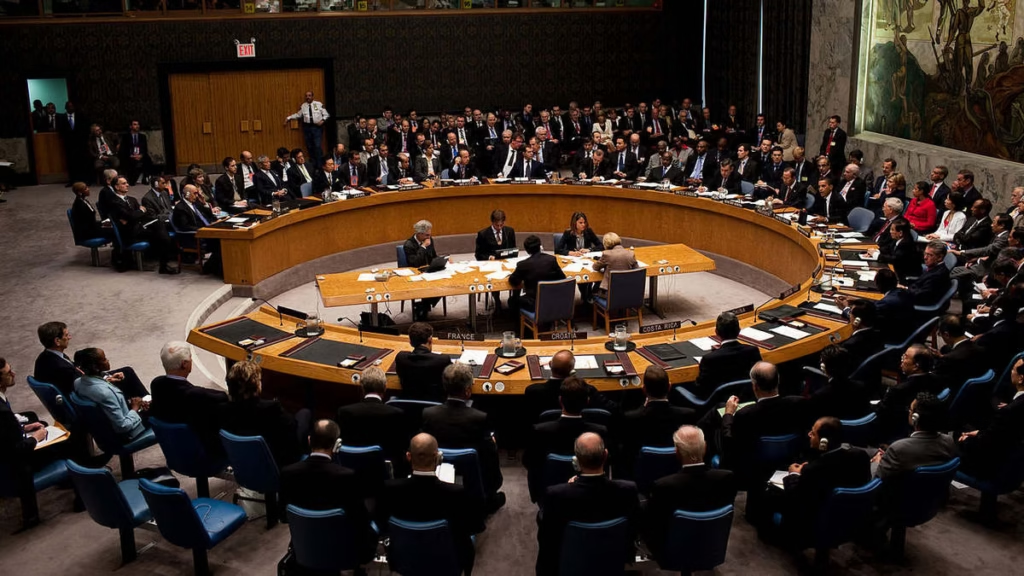
As such, the UNSC’s decisions are symbolic and legally binding. Even when the UNSC is at a standstill, its decisions remain at the forefront globally for many countries, and so many countries continue to invest their diplomatic capital at the UNSC. Thus, India’s recognition of the institution’s limitations is clear. However, India is aware of the legitimacy that is provided through the UNSC. Oftentimes international recognition is obtained through a formal decision of the UNSC. Therefore, through the existing system of the UNSC, India looks to find space within it, which is merely imperfect. Instead of totally rejecting the UNSC system, India uses a strategy to maximise the usage of the limitations of the UNSC.
How India’s UNSC Membership Could Reshape Global Governance
The global placement of India has changed a lot over the last few decades, with growth in many sectors of the economy. India has also become one of the most populous countries in the world. As a result, India’s population size greatly affects global conversations today. India’s diplomatic presence in the world has also increased significantly. India participates fully across all multilateral and regional platforms. Furthermore, India identifies itself as a representative of the Global South. By taking on this leadership role, India is influencing its current institutional expectations.
India believes that global institutions should reflect today’s realities and that post-World War II institutions do not accurately reflect how world power is distributed today. For this reason, India is asking for representation in major organizations and will continue to seek representation as the basis for structural change rather than ambition alone. Through this process, India wants to use the influence it has in the global arena to influence global institutions correspondingly. Thus, India appears to have both a strategically motivated position and a possibly systemic effect on the overall distribution of global power and authority.
Representation offers influence, protection, and agenda-setting capacity
Global governing institutions create the conditions for decision-making, agenda setting, priority setting, and diplomatic negotiations that go beyond immediate conflict situations. Membership in global governing institutions is of great strategic importance, as permanent membership has a direct influence on decision-making and allows Member States to participate in the agenda-setting processes of the organisation. Furthermore, having veto power represents a form of diplomatic protection, as Member States can use their veto to block decisions that are contrary to their vital national interests.
India considers this to be an essential strategic safeguard, as it is not seeking dominance through membership, but instead is seeking balanced representation in global governance. In addition, India’s balance of representation in global institutions is shaped by the regional security environment. Since China is already a Permanent Member of the Security Council, the representation of Asian countries on the Security Council is currently unbalanced. India wishes to obtain membership in the Security Council in order to restore balance within its region. Therefore, India’s call for membership in the Security Council can be viewed in the context of larger geopolitical concerns.
India UNSC Strategy Expands Beyond the United Nations Framework
Rather than relying purely on reforming the UN Security Council, India has sought to create influence on a variety of global platforms. For example, during the recent G20 leadership process, India played a central role in negotiations and activities. At the same time, India has convened diplomatic engagements focused on the Global South, engaged in international strategic forums, and engaged in development partnerships with countries in Africa and Asia in order to build its regional influence — demonstrating a broader diplomatic strategy of expanding India’s presence across multiple institutional spaces or platforms.
Thus, India’s approach to international diplomacy goes beyond just focusing on one international organization but still recognizes that the UN Security Council commands a unique level of authority, combining legitimacy with influence and being involved in decision-making processes. As a result, India continues to pursue reform of the UN Security Council within this unique context, as well as frame its demands for reform as part of a broader global reform dialogue because many countries are now seeking a broader level of institutional representation, greater inclusion in institutions from Asia, Africa, and Latin America. Thus, India’s position in seeking reform on the UN Security Council is in line with the collective narratives surrounding the reform of international institutions.
India UNSC Debate Raises Questions About Global Institutions
The India debate has relevance beyond India’s solitary aspirations. It raises a broader question of global governance systems. Do institutions change as global geopolitics evolves today, or do they remain fixed in their historical arrangements forever? India makes this global institutional challenge more apparent. It interacts with the global governance system, while at the same time, it challenges the limitations of the global governance system. Therefore, the discussion continues to be open-ended and evolving.
For more-https://civiclens.in/category/national-news-civiclens-in/
About the Author