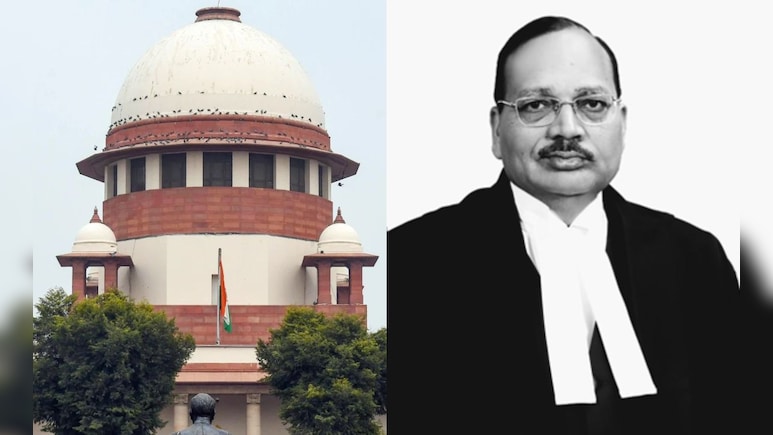
New Delhi, October 30: The Government of India has Justice Surya Kant Appointed as the 53rd Chief Justice of India (CJI). He will take charge on November 24, 2025, a day after Justice B.R. Gavai retires from the top post. Justice Surya Kant will serve as CJI for nearly 15 months, until February 9, 2027, when he reaches the retirement age of 65.
The Department of Justice under the Union Law Ministry issued the official notification confirming his appointment. With this, Justice Surya Kant — a senior judge of the Supreme Court — will lead the Indian judiciary during a crucial period of judicial reform and digital transformation.
Announcing the decision on X (formerly Twitter), Law Minister Arjun Ram Meghwal wrote:

“In exercise of the powers conferred by the Constitution of India, the President is pleased to appoint Shri Justice Surya Kant, Judge of the Supreme Court of India, as the Chief Justice of India with effect from November 24, 2025. I convey my heartiest congratulations and best wishes to him.”
The appointment of Justice Surya Kant marks a continuation of the seniority principle in judicial succession, ensuring a smooth transition at the helm of the country’s highest court.
Early Life and Education
Born on February 10, 1962, in Hisar district, Haryana, Justice Surya Kant grew up in a humble, middle-class family. He completed his graduation from Government Post Graduate College, Hisar in 1981. Later, he earned his Bachelor’s degree in Law from Maharishi Dayanand University, Rohtak in 1984.
Immediately after completing his degree, he began practicing at the District Court in Hisar. A year later, in 1985, he moved to Chandigarh to pursue a full-time legal career at the Punjab and Haryana High Court. Justice Surya Kant Appointed Over time, he built a solid reputation for his expertise in Constitutional, Civil, and Service law.
He represented several key institutions including universities, government boards, corporations, and banks, and even appeared on behalf of the Punjab and Haryana High Court itself. His diligence and courtroom clarity soon earned him recognition as one of the region’s most respected lawyers.
A Trailblazing Legal Career
Justice Surya Kant achieved a remarkable milestone when he became the youngest Advocate General of Haryana on July 7, 2000. His appointment reflected both his legal brilliance and his ability to balance constitutional principles with practical governance.
In March 2001, he received the prestigious designation of Senior Advocate. He continued as Advocate General until his elevation as a permanent judge of the Punjab and Haryana High Court on January 9, 2004.
Furthermore, he served as a Member of the Governing Body of the National Legal Services Authority (NALSA) from February 23, 2007, to February 22, 2011, across two consecutive terms. During this period, he played an active role in promoting legal aid and access to justice for underprivileged citizens.
On May 24, 2019, Justice Surya Kant was elevated to the Supreme Court of India, where he contributed to several landmark rulings. His judgments often reflected compassion, balance, and a deep understanding of constitutional ethics.
Judicial Outlook and Vision
Known for his calm demeanor and analytical precision, Justice Surya Kant has consistently advocated for judicial independence, efficiency, and transparency. He believes in using technology to make justice more accessible and in simplifying court procedures to reduce case pendency.
As the next Chief Justice of India, he is expected to focus on strengthening institutional integrity, improving citizen-centric reforms, and reinforcing public trust in the judiciary. Moreover, his leadership is likely to shape key judicial decisions in the years leading up to 2027, https://main.sci.gov.in
An Inspiring Journey
Justice Surya Kant’s journey — from a small-town lawyer in Hisar to the highest judicial office in India — highlights his dedication, perseverance, and unwavering commitment to the Constitution. His story inspires a generation of young lawyers who aspire to serve justice with integrity.
As India prepares for his swearing-in on November 24, 2025, the legal fraternity anticipates a tenure marked by progressive thinking, reform-driven policies, and a continued emphasis on equality before law.
FOR MORE UPDATES- https://civiclens.in/category/national-news-civiclens-in/
About the Author