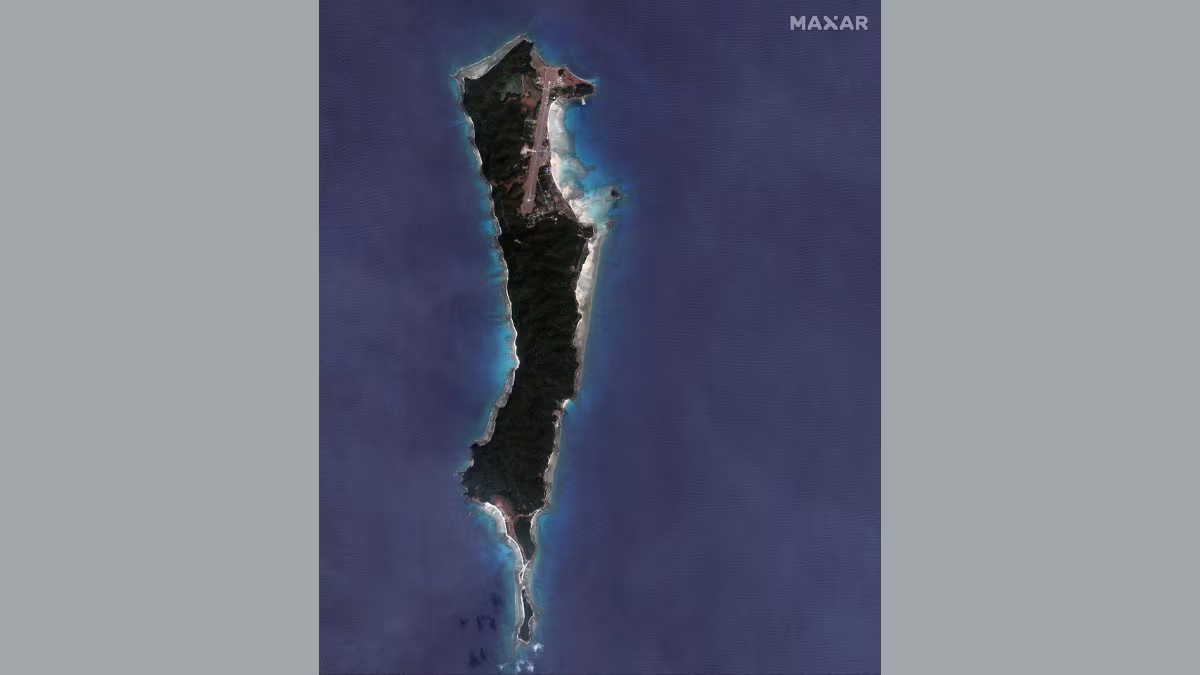
New satellite imagery has triggered major strategic concern in New Delhi. Though Myanmar’s remote Coco Island lies a mere 58 km north of India’s Andaman and Nicobar Islands, it hosts fewer than a thousand people and almost no commercial activity. Yet today, this quiet island has become a critical node in the intensifying India-China rivalry across the Indian Ocean.
Recent imagery shows that Coco Island’s 1,400-metre dirt runway has been fully rebuilt into a 2,300-metre concrete airstrip-long enough to host advanced Chinese-built fighter aircraft such as the J-10, larger transport aircraft such as the Y-8, and airborne early-warning platforms like the KJ-500. A powerful new over-the-horizon radar has appeared on the northern ridge of the island. Reports indicate that it can surveil 500–600 kilometres inside Indian airspace and track naval movements deep into the eastern Indian Ocean.
The question is obvious
Why does a tiny island with no tourism and no civilian flights suddenly need an airbase strong enough for fighter jets and a strategic military radar? Intelligence agencies across India, the United States and Japan broadly agree on the answer—China. According to analysts, Myanmar’s military junta is upgrading Coco Island using Chinese funds, Chinese engineers and Chinese equipment. The purpose, they say, is to give Beijing a forward surveillance post only a short distance from one of India’s most important military regions.
Larger geopolitical contest
China relies heavily on the Indian Ocean for energy and trade: about 80 percent of its crude oil, 60 percent of its total trade, and nearly half of the world’s container traffic pass through these waters. Most of this traffic is funneled through narrow chokepoints-the Strait of Malacca, the Strait of Hormuz, and the Bab-el-Mandeb. A disruption at any of these points-even for a few days-could shake global markets and cripple China’s industrial economy.
India, with its Andaman and Nicobar Command facing the entrance of the Malacca Strait, has a natural geographical advantage. It can monitor or influence traffic entering and leaving this critical sea lane with 572 islands spread across an 800-kilometre arc. In the event of a dispute, India might be able to disrupt China’s oil lifeline-an outcome Beijing sees as one of its biggest strategic vulnerabilities.
Over the last two decades
China has developed what analysts term the “String of Pearls”—a network of commercial ports, military facilities and intelligence bases across South Asia and East Africa—with deep investments in Chittagong in Bangladesh, Kyaukpyu in Myanmar, Hambantota in Sri Lanka, Gwadar in Pakistan, Djibouti in the Horn of Africa, Bagamoyo in Tanzania, Lamu in Kenya, and the Ream naval base in Cambodia.
Many of these have hosted Chinese navy submarines, surveillance ships and warships many times under the cover of commercial or research missions. Together, they form a strategic arc that can monitor India and secure China’s vital sea routes. India’s response to this is its own “Necklace of Diamonds”-a web of alliances, access agreements, forward bases and maritime partnerships to secure the balance of power in the Indian Ocean.
New Delhi has substantially enhanced infrastructure on the Andaman and Nicobar Islands, building longer runways, adding advanced radars, strengthening naval facilities and deploying greater numbers of aircraft and submarines. India has secured access to Indonesia’s Sabang port near the western entrance to the Malacca Strait, restarted work on a new base at Seychelles, expanded cooperation with Oman’s Duqm port and operationalised the Chabahar port in Iran.
India has also forged strong maritime partnerships with the United States, France, Australia, Singapore, and Japan, while hosting large multilateral exercises such as Milan 2024 with 51 participating navies. New Delhi simultaneously supplies coastal surveillance radars, patrol vessels, and defense equipment-including BrahMos missiles-to countries across the Indo-Pacific to offset China’s influence.
ALSO READ: Malaysia to restart search for missing MH370 as families push for closure
Strategic contest
The strategic contest between India and China in the Indian Ocean is not a loud conflict but a quiet, continuous struggle over ports, islands, tracking stations, and geopolitical influence. China brings financial power and aggressive infrastructure investment.
India counters with geography, diplomacy, and a growing network of trusted partners. The result of this silent maritime rivalry, over the next decade, would shape not only India-China relations but also the future balance of power in the Indo-Pacific region.
FOR MORE: https://civiclens.in/category/international-news/
About the Author