Breakthrough Discoveries in the Immune System for the Nobel Prize 2025
Mary E. Brunkow, Fred Ramsdell, and Shimon Sakaguchi are recipients of the 2025 Nobel Prize in Physiology or Medicine for their groundbreaking research on immune system tolerance to self-tissues. These discoveries uncovered the mechanisms of peripheral immune tolerance and the significance of a specialized group of immune cells called regulatory T cells in protecting from autoimmune diseases.
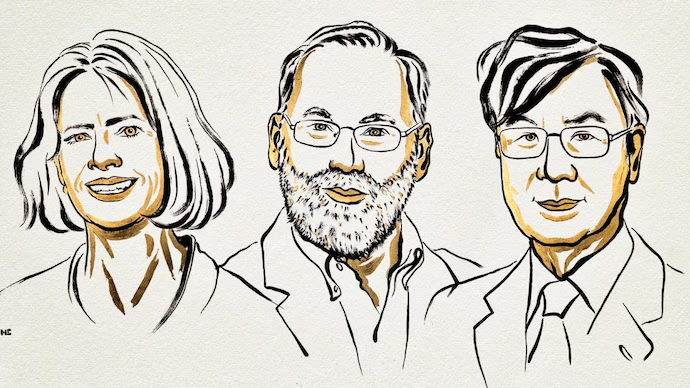
Profiles of Nobel Laureates in the 2025 Medicine Award
Mary Brunkow (b. 1961) completed her Ph.D. at Princeton University and is currently the Sr. Program Manager at the Institute for Systems Biology in Seattle. Fred Ramsdell (b. 1960) graduated with a Ph.D. from UCLA and is now the Scientific Advisor at Sonoma Biotherapeutics in San Francisco. Shimon Sakaguchi (b. 1951) completed his M.D. and Ph.D. from Kyoto University, Japan, and is now a Distinguished Professor at the Immunology Frontier Research Center, Osaka University.
Understanding Immune System Tolerance and Autoimmunity
In their studies, they answered an essential question: how does the immune system differentiate between general threats and the body’s own tissues? Every day, the immune system protects the body against thousands of microbes. However, many pathogens can mimic human cells to escape immune system detection; therefore, without proper regulation, the immune system could inadvertently engage its own organs.
Sakaguchi’s Discovery of Regulatory T Cells
In 1995, Shimon Sakaguchi made a significant discovery, refuting the belief that immune tolerance was only due to the deletion of harmful immune cells in the thymus, which is referred to as central tolerance. He discovered that regulatory T cells function to regulate immune responses and prevent autoimmunity.
Genetic Breakthroughs by Brunkow and Ramsdell
In 2001, with genetic studies, Brunkow and Ramsdell made great strides in this area of research. They studied a strain of mouse susceptible to autoimmune disease and identified a mutation in a gene they named Foxp3. The mutation caused a deficiency in regulatory T cells and hence produced a very severe disease. More importantly, they showed that mutations of the human homologue of Foxp3 were responsible for IPEX syndrome, an especially severe autoimmune disease.
Foxp3 as Master Regulator of Regulatory T Cells
Two years later, Sakaguchi confirmed that Foxp3 was the master regulator of regulatory T cell development, and that these immune “guardians” are meant to protect the body from immune responses directed towards real threats, and not the body itself. Olle Kämpe, chair of the Nobel Committee, said, “Their discoveries have by now been critical for our understanding of why we do not all develop serious autoimmune diseases.”
Global Impact of the Nobel Prize 2025 Medicine Discoveries
Moreover, these discoveries in immunology have paved the way for new medical therapies. The mechanisms of peripheral tolerance can form the groundwork for new epigenetic treatments for autoimmune diseases, cancer, or organ transplantation. There are various Foxp3-based therapies currently being tested in clinical trials, and these therapies could potentially improve the outcomes for a patient’s health, as well as increase transplant success rates.
The 2025 Medicine Nobel Prize recognizes three scientists, whose combined work has literally changed the course of treatment for immune-mediated diseases, along with potentially many other diseases that involve the immune system. Their discoveries not only advance our understanding of the immune system but also offer hope to millions suffering from autoimmune and inflammatory diseases worldwide.
Read the full Nobel Prize announcement-http://Read the full Nobel Prize announcement
For more – https://civiclens.in/category/international-news/
About the Author