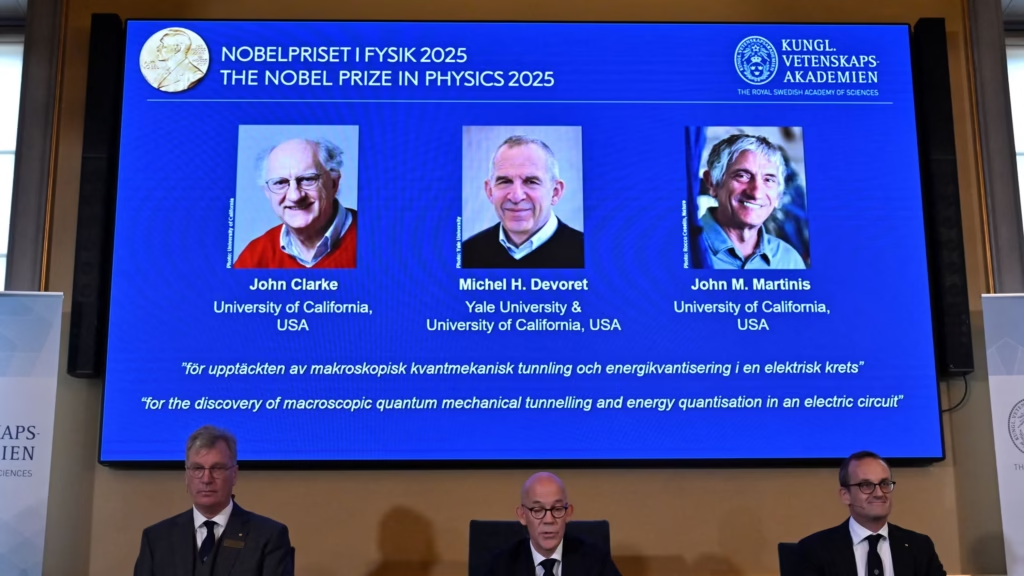
The Nobel Prize in Physics 2025 quantum mechanics has been awarded to John Clarke, Michel H. Devoret, and John M. Martinis for their groundbreaking research in quantum mechanical tunnelling and energy quantisation in electric circuits. The Royal Swedish Academy of Sciences made the announcement on Tuesday, praising their discovery for reshaping modern physics and digital technology.
Pioneering the Quantum Frontier
The Nobel Committee honoured the trio “for the discovery of macroscopic quantum mechanical tunnelling and energy quantisation in an electric circuit.” Their experiments showed that quantum behaviour, normally seen at atomic scales, can also appear in larger systems. Consequently, their findings proved that quantum principles can extend beyond the microscopic world, Nobel Prize in Physics 2025 quantum mechanics.
Moreover, by demonstrating these effects in measurable circuits, the scientists successfully connected theoretical ideas with practical technology. As a result, their work has opened the door to quantum cryptography, quantum sensors, and especially quantum computers, which could transform the future of information processing.
A Discovery with Lasting Impact
During the announcement, the chair of the Nobel Committee for Physics emphasized that quantum mechanics forms the base of all digital technology. Furthermore, the committee added that this discovery not only deepens scientific understanding but also builds the foundation for future technological innovations.
In simple terms, quantum tunnelling allows particles to move through barriers that seem impossible to cross under classical physics. Clarke, Devoret, and Martinis turned this abstract theory into a real, observable effect by using superconducting circuits. Consequently, their work paved the way for quantum bits (qubits)—the building blocks of modern quantum computers.
Reactions from the Laureates
After the announcement, John Clarke, a British-born professor at the University of California, expressed complete surprise. “I’m absolutely stunned,” he said. “It never occurred to me that this could lead to a Nobel Prize. Honestly, it’s the surprise of my life.”
In addition, Clarke mentioned that the true impact of their discovery is still emerging. “Our discovery, in many ways, became the basis of quantum computing,” he explained. “Exactly how it fits today is still developing.”
Bridging Science and Technology
Quantum computing works in a way that challenges classical logic. Instead of using bits that represent 0 or 1, quantum computers use qubits that can exist in multiple states at once. This unique property, called superposition, lets them perform many calculations simultaneously. Therefore, quantum computers can solve certain problems far faster than traditional machines.
Furthermore, the trio’s research provided a strong experimental base for this technology. Their insights into macroscopic quantum behaviour made it possible to design circuits that preserve quantum coherence, which is essential for reliable qubits.
The Road Ahead
Although quantum computing is still evolving, the Nobel Committee noted that the laureates’ discoveries will continue to guide scientists worldwide. Moreover, the technologies inspired by their work may soon revolutionize industries such as cybersecurity, pharmaceutical research, artificial intelligence, and finance.
As Michel H. Devoret, a professor at Yale University, explained in an earlier interview, understanding how to use quantum mechanics in real systems remains “a scientific and philosophical challenge.” Thus, the 2025 Nobel Prize recognizes not only their success but also the path they have set for future exploration.
https://www.nobelprize.org/prizes/physics/2025/press-release/
A Legacy of Curiosity and Collaboration
The accomplishments of Clarke, Devoret, and Martinis highlight the importance of teamwork across borders and generations. In fact, their collaboration combined decades of theoretical insight with new experimental precision. Consequently, their success continues to inspire young researchers to explore the mysteries of the quantum world.
Ultimately, as the world celebrates their achievement, one message stands out clearly: the line between science fiction and scientific reality is fading fast. Through their vision and dedication, these scientists have turned invisible quantum principles into real tools that may shape the future of technology and human progress.
Finally, the award ceremony will take place in Stockholm this December, where the trio will receive their Nobel medals, diplomas, and a shared prize of 11 million Swedish kronor.
For more update- https://civiclens.in/category/international-news/
About the Author