Rising bioweapon threats are shaping India’s security outlook as Jaishankar highlights the accelerating risks posed by rapidly advancing technologies and increasingly capable non-state actors. Jaishankar points to quickly emerging dangers, as the capabilities of Non-State Actors grow at an alarming rate compared to the rate of advancement in technology. Technology moves faster than the advancement of safeguards, while worldwide systems remain outdated. Additionally, vulnerable areas of the globe face an increased risk. Consequently, India is preparing to respond to a future that may include an increased number of biological threats.
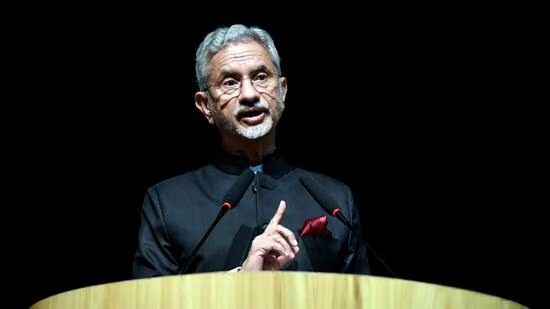
There is an urgent need for India and the international community to reform the Biological Weapons Convention without delay, mainly because there are no compliance processes in place. The rise in global bioterrorist threats should also be considered, as it means misuse is “no longer a theoretical possibility.” This statement mirrors India’s current security evaluation, and Jaishankar is calling for verification methods to be developed for a more modernised method of determining the effectiveness of technology in rapid innovation through the scientific review process.
India pushes modernization of global biosecurity systems amid rising bioweapon threats
In India, Jaishankar stresses a strong regulatory approach. He also stresses the importance of tracking scientific developments in real time. Jaishankar expressed concern about structural gaps within the BWC – specifically, he argued that there is no “permanent technical body” to the convention’s framework, a problem that must be addressed. He expressed Indian support for international frameworks that promote peaceful scientific collaboration and support global mechanisms for open exchange of information related to scientific research and development.
In his presentation, he also provided an extensive overview of India’s National Implementation Framework (“NIF”). The NIF provides comprehensive coverage of risk assessments related to dangerous agents. Additionally, the NIF enhances oversight over dual-use research and development as well as provides enhanced training and reporting procedures for all emergency response organizations. He covered a number of other components related to incident management. India has committed to providing “fast, practical, and humanitarian” assistance during times of crisis, and this is a fundamental principle of the NIF. Indeed, as India’s science continues to grow and advance, so will the systems of the NIF.
Global South emerges as central to future biosecurity planning
Dr. S. Jaishankar has pointed out, however, that there are large disparities in levels of protection against the spread of infectious diseases between countries across the world. Today, many countries have weak, fragile health systems. There are severe limits to the number of laboratories available to diagnose and detect disease early. Inadequate laboratory facilities and systems for reporting and monitoring disease activities and outbreaks exacerbate regional and national vulnerabilities. Therefore, the need for cooperation among nations in order to maintain global stability and health security will continue to grow. Dr. Jaishankar states that diseases can “move quickly, and do not respect borders,” so as a result, countries need to build shared capabilities rapidly.
India’s expanding global footprint means that it is now in a position where it has acquired additional responsibilities with regard to responding to and helping to prepare for the threats of infectious diseases. Today, India is one of the largest suppliers of generic medicines to countries around the world. The vaccine ecosystem that India has developed represents a major advancement in the overall preparedness of countries around the world to respond to and mitigate the impacts of the pandemics of yesterday and today.
India is also currently in the position of having some of the most sophisticated research and laboratory facilities available in the world, which enables it to respond quickly to emerging infectious diseases through rapid detection and response capabilities. Further, Dr. Jaishankar asserts that the countries of the Global South will play an increasingly larger role in defining the global health agenda in the coming decades, and therefore, must have a voice in shaping the future of the Biological Weapons Convention (BWC), and thus positioning India as a trusted partner in the Global South.
For more- https://civiclens.in/category/international-news/
About the Author