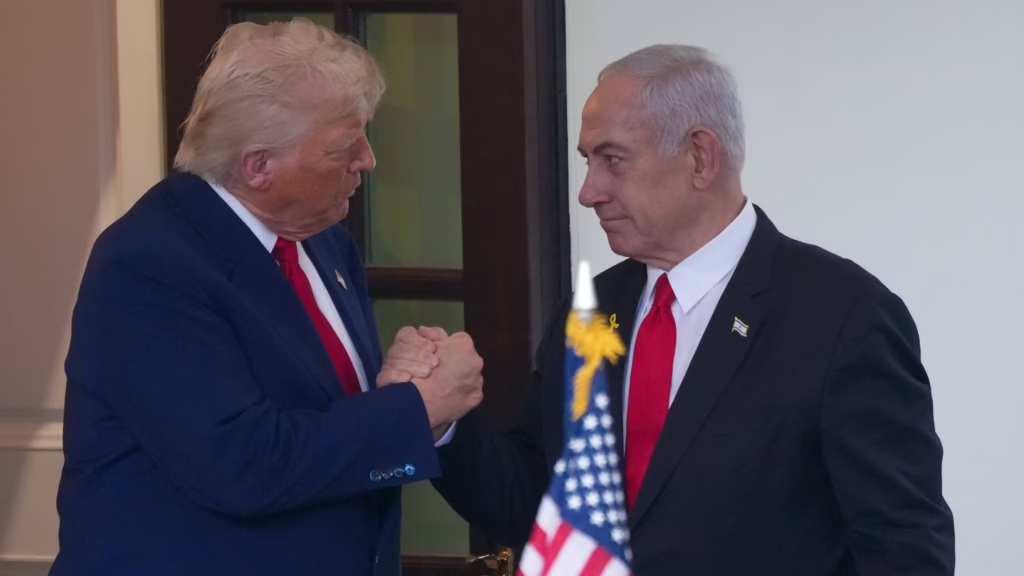
The White House has released a 20-point plan to bring an end to the war in Gaza, reviving hopes but also tough questions regarding whether or not peace is finally within reach. The plan, revealed by President Donald Trump and Israeli Prime Minister Benjamin Netanyahu, guarantees a ceasefire, hostage release, and a plan for reconstructing Gaza. However, critics say it could be more of an ultimatum rather than a fair peace agreement.
What the US Plan Expects
Essentially, the plan aims to freeze hostilities right after Israel and Hamas have reached an agreement. Israeli soldiers would retreat from an agreed line, with airstrikes and artillery fire stopping. Hamas would be expected to release all the hostages within 72 hours of Israel’s public endorsement.
In return, Israel would let go of about 2,000 Palestinian detainees, including the life-term prisoners. The agreement calls for 15 Palestinian corpses to be brought back for every Israeli hostage corpse returned.
The strategy involves a demilitarised Gaza free of Hamas armaments, run in the short term by a technocratic Palestinian committee subject to international oversight. It would be controlled by a so-called “Board of Peace” headed by Trump himself, with names like Britain’s former Prime Minister Tony Blair cited as possible members.https://news.un.org/en/story/2025/09/1165995
The White House maintains that Israel will not annex Gaza, but Hamas will receive no governing authority, directly or indirectly. International assistance, managed by UN and Red Crescent oversight, would enter Gaza for the rebuilding process.
What’s at Stake for Gaza and Hamas
The proposal puts Hamas to a stark decision: disarm, take amnesty, or depart Gaza. Those combatants willing to abandon violence are permitted to remain, but others would be granted “safe passage” elsewhere.
For regular Palestinians, the agreement promises humanitarian aid and foreign money to rebuild war-torn districts. It also introduces the hope of eventual Palestinian statehood — but only as a far-off vision, dependent on Palestinian Authority reforms.

Commentators say that this provision is intentionally vague. It does not obligate Israel to accept a Palestinian state, nor does it provide a specific time frame.
Why Implementation Looks Difficult
On paper, the strategy has the capacity to bring to a close one of the deadliest wars in the history of Gaza — a war that started following the October 7, 2023 Hamas attack on Israel that claimed approximately 1,200 lives and resulted in the taking away of 250 hostages. Since then, 66,000 Palestinians have died, Gaza health officials report.
But the politics are convoluted. Hamas would not sign an agreement that would disarm it and remove it from power altogether. Within Israel, Netanyahu is under pressure from hard-right coalition partners who will not accept any concessions and who reject any Palestinian Authority role in Gaza.
Clarifying details are also sketchy: Which nations will send troops to an “International Stabilisation Force”? Who determines when Gaza is “secure” and Israel can leave? And what if both sides accuse the other of not keeping up their end?
A Peace Deal or a Surrender Demand?
Opponents state the plan is more akin to reading like a peace deal than a surrender ultimatum to Hamas on US-Israeli terms. “It’s either peace on Trump’s terms or escalation with US support,” offered one Middle East analyst.
For Israeli hostage families and Gaza civilians under siege, though, even a deficient agreement might prove preferable to constant combat. As one exiled Palestinian in Khan Younis explained: “We just want the war to stop. Politics can wait — life cannot.”
The Road Ahead
Trump gave Hamas mere days to react. Netanyahu pledged that if the Palestinians in Hamas reject or sabotage the deal, Israel will “finish the job” with the backing of America.
The next week may determine if Trump’s 20-point roadmap becomes a road to peace — or the beginning of another lethal chapter in the conflict between Israel and Gaza.
FOR MORE : https://civiclens.in/category/international-news/
About the Author




3 thoughts on “Unraveling Trump’s Gaza Peace Plan”