Trump Iran deadline has intensified global uncertainty as diplomacy tightens under growing military pressure. Tension mounts in the countdown to an escalation of hostilities between Washington and Tehran. Meanwhile, diplomacy continues despite an increasing military presence in the region. President Trump has made several urgent public statements that are intended to convey to the Iranians that they must meet his demands by a specific date. This has created a climate of uncertainty in financial and political markets globally.
As a result, there is ongoing discussion in Switzerland among diplomatic representatives with no positive end in sight, and military deployments are continuing to grow throughout the Middle East. The USS Abraham Lincoln is now positioned further in the region, meaning that each day the stakes will increase dramatically. Iran has issued a warning through its representatives at the United Nations that it has no intention of starting a war; however, Iranian officials have warned that they will retaliate against an attack.
Therefore, the likelihood of miscalculating throughout the region is growing. Some legislators in Washington are questioning the President’s unilateral authority; however, the administration continues to publicly emphasize its preference for a diplomatic solution. The world is now watching as this situation plays out on a highly condensed time frame.
Trump Iran Deadline Sets Ten-Day Clock as Military Options Loom
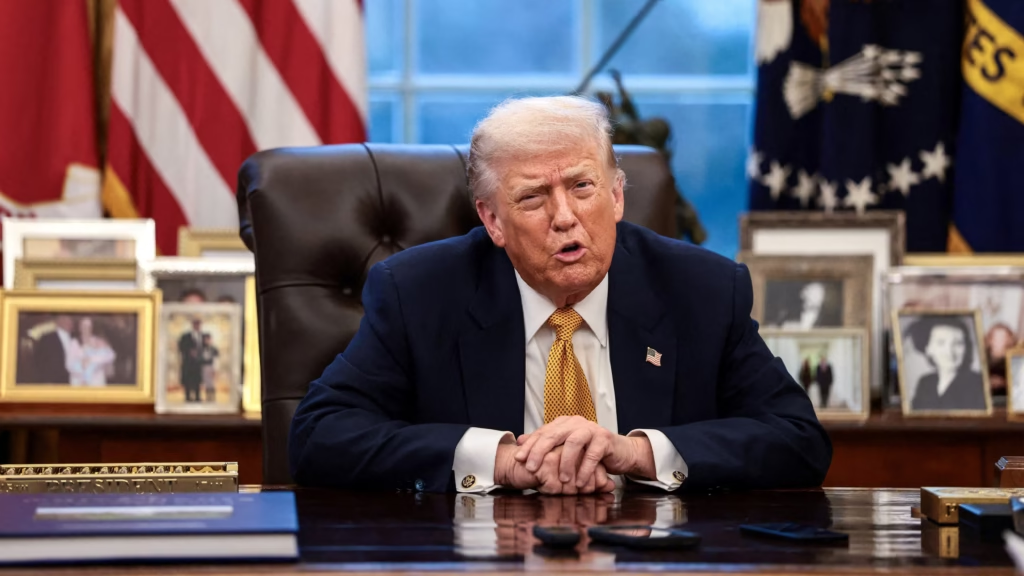
During a speech in Washington, D.C., President Trump expressed his seriousness regarding Iran. “We have to make a meaningful deal, otherwise bad things happen,” he stated. Additionally, he indicated that decisions regarding Iran would be made shortly. There will be definitive announcements within days, Trump claimed.
In addition to confirming the difficulty of the negotiations, he praised the ambassadors involved in reaching an agreement. “It’s proven to be, over the years, not easy to make a meaningful deal with Iran,” he noted.
While Congress has attempted to restrict Presidential actions using the War Powers Act and warned against taking unilateral action against Iran due to possible catastrophic regional outcomes, Iran continues to communicate its willingness and ability to escalate military operations (i.e., conducting military exercises) and to utilize social media as a means of communicating with the West. In other words, while diplomacy decreases the likelihood of both the United States and Iran reaching a successful agreement, the deterrent against an armed attack on Iran is simultaneously increasing.
Oil markets ease as supply fears compete with diplomacy
Oil prices declined again following Trump’s announcements. Brent crude has fallen despite hitting a new six-month high. In addition, US benchmarks have fallen substantially due to changes in demand versus supply. Many traders are considering potential supply problems while stockpiling a lot of supplies. However, heightened tensions in the Middle East continue provide upward momentum for oil prices. According to Trump, “bad things will happen” if no deal is reached, though he stated that decisions should be made within 10-15 days.
As a result of the recent uncertainty surrounding the situation, traders responded cautiously, as there is still a substantial amount of available crude on the market. The fact that China has been continuing to stockpile is also supporting demand for oil. Global freight rates are still at high levels, but Iran continues to be the main risk to energy markets. Experts are warning that conflict may occur shortly in relation to Iran. Iran has vowed to retaliate against acts of aggression. Thus, energy markets will be highly reactive to all news over the next few days, and the pricing of geopolitical risk may change significantly.
For more- https://civiclens.in/category/international-news/
About the Author


