The recent U.S. capture of Venezuelan President Nicolas Maduro has sparked strong global reactions, with the international community grappling with issues of international law, sovereignty, and the future of Venezuela’s governance.
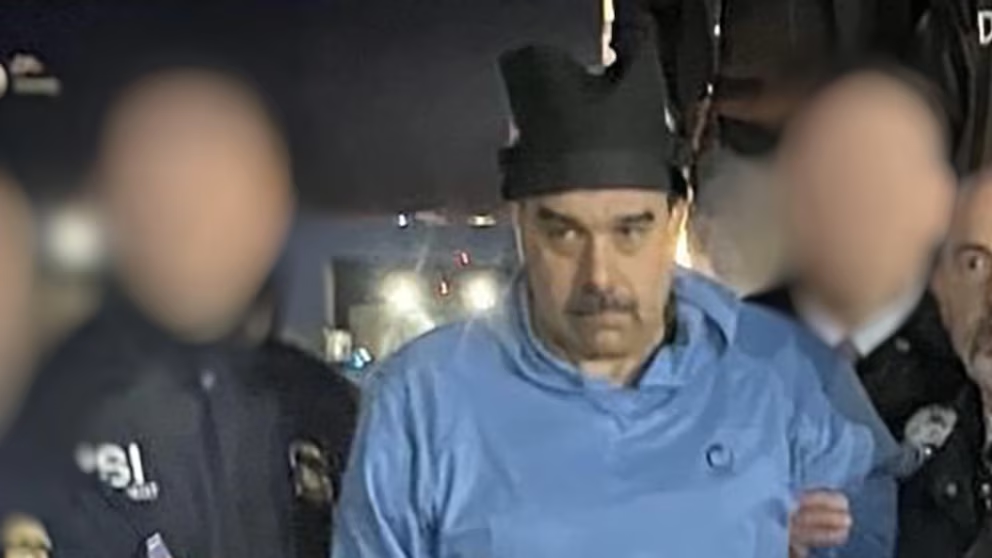
U.S. President Donald Trump announced early Saturday that a team of U.S. soldiers arrested Maduro and his wife, Cilia Flores, during a large-scale overnight operation in Venezuela and brought them to the U.S., where both have been indicted for crimes involving drugs. According to U.S. officials, the arrests and indictments of both Maduro and Flores mark the United States’ most direct military involvement in Latin America in decades and have caused controversy regarding Washington’s military interventions abroad.
Latin America split along ideological lines
Latin America is divided after Maduro’s arrest
The reaction to President Nicolás Maduro’s overthrow (and, ultimately, arrest) by U.S. military forces at the behest of ‘Mr. Trump was immediate and sharply split—divided equally along political lines.
As one of the strongest responses, Brazilian President Luiz Inácio Lula da Silva went on record with a robust condemnation of the U.S.-led military operation as “a serious violation of both the sovereignty of Venezuela and international law.
In his statement, Lula made clear that the bombing of Venezuelan soil and subsequent seizure of President Maduro crossed an “unacceptable line” and warned that actions of this sort have set in motion “some of the worst periods of foreign interference” throughout Latin America.
Other Latin American countries that issued statements rejecting this military intervention include Mexico, Chile, Uruguay, and Cuba. The Mexican Government stated it “condemns and rejects all forms of unilateral military intervention.” Additionally, Mexico reiterated its belief that the only acceptable means of resolving political crises in Venezuela is through dialogue and negotiation.
On the other end of the spectrum, several right-wing governments throughout Latin America expressed approval of such actions taken by the United States. In this way, Javier Milei—President of Argentina and strong supporter of Mr. Trump—heralded this news via social media, exclaiming, “Freedom is Winning as We Speak! Long Live Freedom!”
Additionally, the President of Panama issued a statement supporting the people of Venezuela, “should the outcomes of their elections result in a democratically elected president.
Global response to US capture of Nicolás Maduro
The reactions of the largest global powers outside the area of contact exhibit deep concern for the situation.
Russian Foreign Minister Sergey Lavrov referred to the US attack as “an act of armed aggression” and “an egregious violation of international law. The People’s Republic of China expressed “deep shock” at the attack and condemned the attack on the sovereignty of a nation. Iran echoed the sentiments expressed by both China and Russia and described the attack as a gross violation of a nation’s sovereignty.
The United Nations expressed its concern over the operation through the Secretary-General’s office. Secretary-General António Guterres stated that he has “significant concerns” that the UN Charter and international law were not followed during the operation and noted that this is a “very dangerous precedent.
European leaders struck a more cautious tone.
EU Foreign Policy Chief Kaja Kallas said that the European Union is continuing to watch what is happening in Venezuela and that they still hold the position that President Maduro does not have the legitimacy of a democratically elected leader; Kallas also emphasized that any actions taken with respect to Maduro or his regime should be in accordance with International Law and the UN Charter.
EC President Ursula von der Leyen also reiterated the calls for a peaceful transition between Presidents Maduro and Guaido.
Pedro Sánchez, Prime Minister of Spain, went further, declaring not only would the Spanish Government not recognize the Maduro regime, but also would not recognize any external intervention which contravenes International Law.
Slovak Prime Minister Peter Pellegrini indicated that the actions taken in Venezuela reflect the collapse of the Post-World War II Global Order.
Many other European states (including Italy and Poland) have indicated that they are communicating through their embassies to ensure the safety of their citizens who currently reside in Venezuela.
mixed reactions at home and abroad
The United Kingdom’s Prime Minister Keir Starmer stated his administration will shed no tears regarding the collapse of Maduro’s governing authority, but refrained from indicating its approval of military force. The French and German Governments stressed the necessity for lawful and stable means through which to create change.
In the United States, there have been a number of negative comments regarding the action against Maduro. U.S. Senate Minority Leader Chuck Schumer indicated that although Maduro is illegitimate, any military action without congressional approval would be “reckless.”
Prime Minister Benjamin Netanyahu of Israel did, however, extend congratulations to President Trump for what he saw as “courageous and historic action.”
What the US capture of Nicolás Maduro means for Venezuela
Responses to the recent developments surrounding the situation in Venezuela have varied widely within the country as well as amongst its diaspora. While some easily view the end of Maduro’s long-standing rule positively, others see it as more of an act of American Imperialism, with many people left confused over who actually has control over this oil-producing country now that they are experiencing political upheaval, and what actions will take place next by either side (U.S. & Maduro) to either lift or continue the sanction process imposed on him (Maduro) due to the ongoing conflict there. Washington continues to investigate options to support a new government for Venezuela; hence, the world community continues to pay close attention to the situation, as well as developments that are presently unfolding surrounding Maduro’s eventual capture.
For more- https://civiclens.in/category/international-news/
About the Author