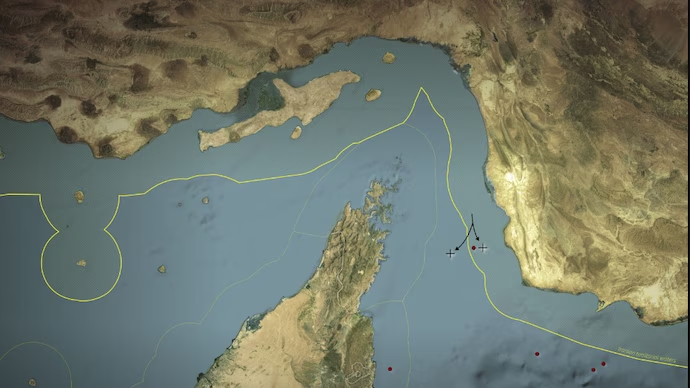
Global energy concerns are currently focused on a narrow waterway. Increasing tensions throughout the Persian Gulf have disrupted some of the world’s most important shipping lanes. As a result, a large number of oil and gas tankers are currently unable to move because of various reasons, leaving them stranded in the area surrounding Indian waters. Sino-India is carefully observing the way this crisis continues to develop. The Strait of Hormuz connects the Persian Gulf with the Sea of Oman. Under normal circumstances, approximately 20% of the world’s oil travels through this passage. Therefore, disruption of this route has immediate and negative ramifications for global markets.
The conflict occurring within the region has thus far resulted in a dramatic decrease in commercial tankers moving within the Persian Gulf region. In addition, through more than 20 vessels carrying cargo to or from Indian ports, the movement of crude oil, propane, and liquefied natural gas (LNG) will continue to be severely limited. Because the importation of energy from the Middle East is very important for India, having nearly 50% of its crude oil coming from there and about 66% of its imported LNG travelling to Indian ports via the same maritime routes, any protracted delay in the commercial movement of vessels will impact India’s energy planning. However, the Government of India quickly engaged its diplomatic efforts and commenced immediate action.
India’s Diplomacy Intensifies as Strait of Hormuz Tensions Rise
Negotiations between India and Iran related to shipping security are currently underway. Negotiations take place between officials from the Ministry of External Affairs and those in Iran. There are over twenty tankers within the vicinity of the Strait; they are carrying liquefied petroleum gas (LPG), liquefied natural gas (LNG), and crude oil. Following the earlier attacks, there was an escalation in tensions in the region, and as a result, the amount of tanker traffic through the Strait of Hormuz was discontinued. On the other hand, analysts have noted a limited number of vessels still conducting cargo transits.
S. Jaishankar, India’s Minister for External Affairs, has been in contact with Iranian leadership on several occasions, primarily through discussions with his counterpart Abbas Araghchi. A ministry spokesman subsequently verified the ministries’ interactions. A briefing was provided, at which time it was explained that maritime security was a central topic and included many other subjects surrounding energy security. On the other hand, Iranian authorities state that there are no timetables for any shipping authorizations. Consequently, the parties involved continue to negotiate, without having finalized shipping authorizations. Furthermore, analysts have recently observed different patterns from the vessels previously reported.
Supply diversification cushions India against Hormuz disruptions
Various oil tankers have turned off their transponders (to avoid being tracked) when operating in certain high-risk shipping zones. Experts refer to these types of ship navigation methods as “dark transit.” Ship-tracking data shows that only a limited amount of stored/shipped goods were tracked post March 1st crossing, including several that arrived in Indian Ports. Regional shipping routes will likely see further uncertainty in shipping times when crossing. As a result, the Indian government has begun to search for other sources of crude supply by looking beyond the Strait of Hormuz.
Recently, Hon. Hardeep Singh Puri (Minister of Petroleum & Natural Gas) addressed Members of Parliament (MPs), assuring them about fuel availability. He said, “The world has not faced a moment like this in modern energy history…India’s crude supply position is secure, and the volume secured exceeds what the Hormuz would have delivered. Before the crisis, approximately 45 per cent of India’s crude imports transited through the Strait of Hormuz route. Thanks to the Prime Minister’s outstanding diplomatic outreach and goodwill, India has secured crude volumes that exceed what the disrupted Strait of Hormuz could have delivered in the same period,” he added.
He also emphasised strong refinery operations nationwide. He said, “The refineries are operating at high capacity utilisation. In several cases, they are exceeding 100%. There is no shortage of petrol, diesel, kerosene, ATF, or fuel oil. The availability of petrol, diesel, aviation, turbine fuel, kerosene, and fuel oil is fully assured. Retail outlets across the country are stocked, and supply chains for these products are functioning normally.”
For more- https://civiclens.in/category/national-news-civiclens-in/
About the Author