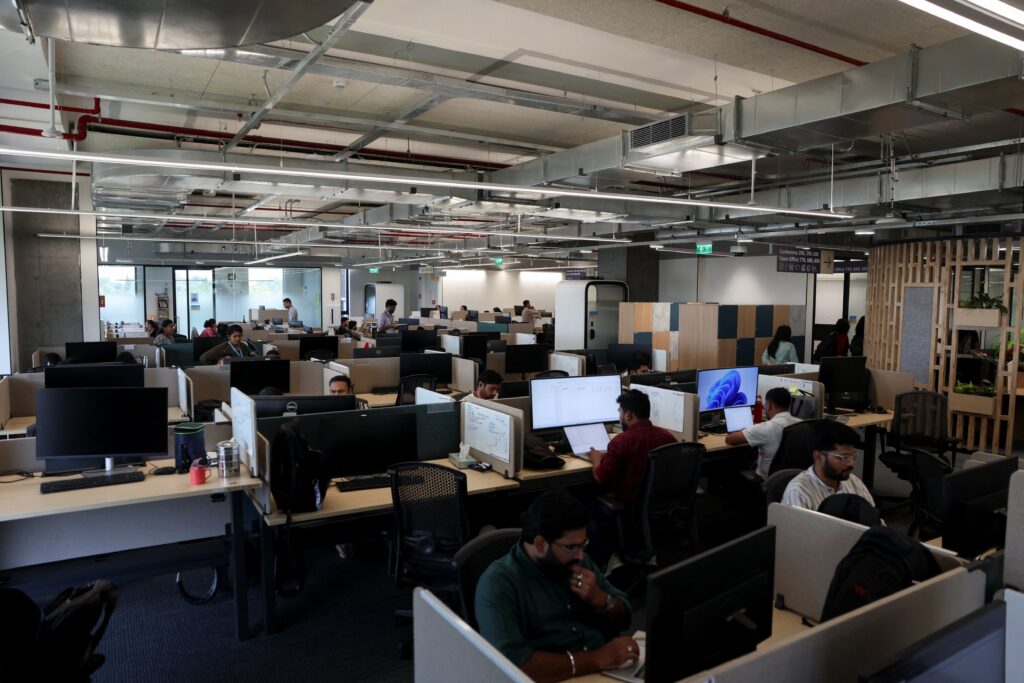
The India Retail GCC market has emerged as the largest globally. The country currently hosts around 180 operational Retail GCCs. One goes to the country, one finds that it already has about 180 working Retail GCCs, where approximately 272,300 people work in total. Its ecosystem features more potential than a combination of five main competitors on the market. Those competitors are Poland, the Philippines, Mexico, Germany, and Egypt.

At the same time, India faces many problems when it comes to finding enough workforce, especially senior experts working in Artificial Intelligence.
India Retail GCC Market Builds Unmatched Global Scale
As per the latest report from TeamLease Digital, India has emerged as the top Retail GCC ecosystem in the world with a significantly greater level of functional diversity compared to other destinations across the globe. This has resulted in retail and e-commerce industries being among the biggest employers of professionals in India, providing jobs for 55.8 percent of professionals. The food, beverage, and ingredients industries account for 15.7 percent of jobs, while personal care and household industries contribute 11.5 percent of jobs.
Bengaluru is the largest retail GCC hub in India, with nearly 84,000 professionals working in various industries. Delhi NCR comes next with over 66,000 professionals, while Hyderabad has around 45,000 professionals.
The hiring activity has increased drastically, with retail GCCs providing more than 52,000 jobs in 2025. Moreover, companies have started to recruit professionals outside the traditional retail industry.
In fact, 90.2 percent of professionals employed in the latest recruitment were from outside of the industry. Most of them were from the domain of IT services, product companies, and consulting companies.
AI growth exposes a shortage of experienced professionals
Nonetheless, the biggest opportunity for growth in India brings along its biggest challenge. Adaptation of AI has been unprecedentedly fast across the Retail GCC. In terms of the extent of AI usage, penetration went up from 2.1% at the beginning of 2022 to 4.8% projected for 2025. The report forecasts the extension of penetration to 7.2% by 2026.
Yet, experienced professionals in the field of AI remain extremely limited. In India, there are only 320 AI professionals with eight and more years of experience among 180 Retail GCCs. It is also important to mention that 54% of this specialized talent is concentrated in Bengaluru, which creates a major threat for companies wishing to expand their operations.
The areas that prevail in terms of employment at present are Technology, Customer Success, and Supply Chain. These areas, according to forecasts, may result in over 80% of hiring demand in 2028. 41,000 professionals will work in Technology and Engineering alone.
India must strengthen its talent pipeline for future growth
Simultaneously, a fierce competition among distinct industries for the most qualified specialist is growing stronger. Professionals who are into AI and machine learning receive excellent salaries, and senior, experienced specialists can make more than ₹1.2 crore by combining professional skills in AI with expertise in the industry.
The problem of attrition persists as an important issue for business leaders. The highest employee turnover happens in those sectors where the employees have only limited experience. As a result, organisations should develop better methods of career development and retention.
Neeti Sharma, the CEO of TeamLease Digital, said that India has gone beyond the borders of just competing through its labour volume. Instead of just implementing other companies, India continues to make its own evolution of AI technologies in retail.
However, to maintain this position, Indian organizations should purposefully invest in qualified specialists. Moreover, it is significant to involve talent from other cities and not only Bangalore.
Thus, despite the current position of India’s Retail GCC sector, which gives a lot of chances for further expansion, the growth might be limited due to a shortage of a talented workforce.
For more- https://civiclens.in/category/technology/
About the Author