There is now a new phase of maritime tension in the Persian Gulf, and the relationship between Iran and other Gulf States will continue to change. Iran has made several strong statements regarding its strategic objectives leading up to the Hormuz crisis, many of which deal with military issues. In addition, they are sending signals that provide information about both their nuclear capabilities and their control over parts of the region.
Also, new U.S-Iran tensions are on the rise globally. As the ongoing events unfold, the global energy markets remain very sensitive to any changes. Thus, it is clear that this deepens a larger geopolitical confrontation, with the Hormuz crisis now entering into a phase with much more of an assertive nature.
Nuclear and missile capabilities framed as non-negotiable national assets
Dar al-Hekmah Institute ~The Foreign Policy Centre. November 2020. ~ Since its early days as a sovereign state, Iran has sought to protect their strategic capabilities and reaffirmed their commitment in January 2020 through statements by Supreme Leader Mojtaba Khamenei emphasizing nuclear and missile power as essential components of Iran’s national assets.
Furthermore, despite continuous statements from the Iranian government stating that it intends to maintain a peaceful nuclear program, the United States has followed through on its long-standing demand for Iran to accept restrictive limitations on its nuclear capabilities. “90 million proud and honorable Iranians, both in and out of Iran, consider it their duty to protect all of Iran’s identity-related, spiritual, human, scientific, industrial, and technological capacities (to include nano-technology and biotechnology, nuclear and missile capacities) as national assets and to protect them, as they do the country’s waterways, lands, and airspace,” he stated. Therefore, there are many significant ideological obstacles to successful negotiations; therefore, there is a significant connection between Iran’s nuclear policy and the ongoing conflict between the two countries.
Iran Hormuz Control Intensifies Maritime and Energy Conflict
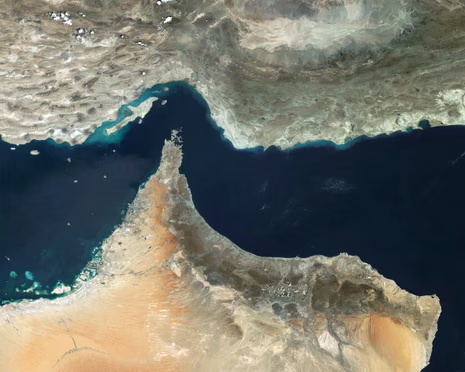
At the same time, Iran has indicated that it will expand their control over the Strait of Hormuz and has suggested alternative rules related to its management. The Strait of Hormuz is one of the main maritime routes where oil is transported throughout the world, and any disruption from Iran has led to significant disruptions of the global energy supply chain; thus, prices have increased significantly due to ongoing ambiguity.
Ayatollah Khamenei described a new chapter within the region and stated that the US military presence causes insecurity within Iran’s borders. Control over the maritime environment will serve as an important pressure application; therefore, the Strait of Hormuz will continue to be the primary source of Iranian military conflict with the United States.
US blockade strategy and global impact shape evolving crisis dynamics
Nevertheless, the U.S. keeps exerting military and economic pressure. It has put in place a blockade that aims for Iranian oil exports. This will create a significant cut to Iran’s revenue. Meanwhile, Washington is looking at ways to re-establish shipping lanes and limit Iran’s ability to exert influence. All of the affected global economies are now experiencing the ripple effects of potentially altered supply; therefore, the result will be growing worldwide energy costs and inflationary risk. As a result, the crisis carries both regional and global ramifications.
Iran Hormuz Tensions Complicate Future Negotiations
Any potential negotiations going forward will likely remain uncertain and multifaceted. Iran has indicated that it has very little willingness to make any compromises regarding its key issues. The United States still wants to see Iran give concessions related to its nuclear program. Pakistan has tried to facilitate indirect dialogue between Iran and the United States. However, there appears to be an enormous amount of distrust that heavily impacts all parties’ engagement with one another. As such, all parties will most likely need to make substantial compromises if a comprehensive resolution is to be reached. Consequently, this conflict looks as if it will continue into the foreseeable future with both strategic and methodical difficulties.
For more- https://civiclens.in/category/international-news/
About the Author