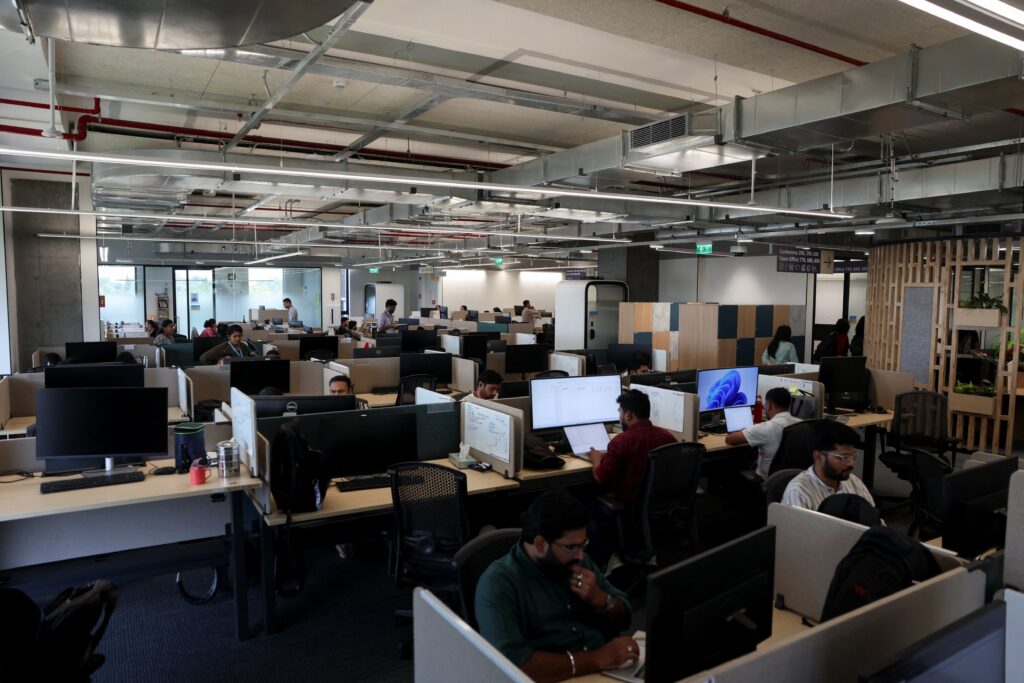
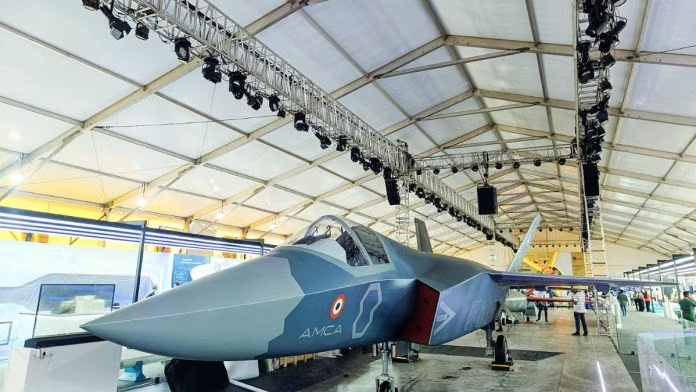
A major shift in defence production in India has begun with the official announcement of the Advanced Medium Combat Aircraft (AMCA) program via a request for proposal (RFP) by the Government of India (GoI). The key difference now is that for the first time in Indian history, the private sector will lead the development of a large fighter aircraft program.
Finally, this giant leap away from complete reliance upon government-owned manufacturers is a revolutionary change in the Indian manufacturing sector. And, this program will continue to further India’s efforts towards self-sufficiency in defence production. Overall, the AMCA program will provide both industrially and strategically important components to redefine India’s industrial aerospace complex.
Private Sector Entry Reshapes India’s Defence Manufacturing Model
The Defence Ministry first excluded Hindustan Aeronautics Limited from being able to bid on the AMCA project and instead chose three bidders from the private sector. The three bidders were Tata Advanced Systems, a consortium of L&T, BEL, and Dynamatic, and another consortium of Bharat Forge, BEML, and Data Patterns. The successful bidder will produce five prototypes and one structural test aircraft. As a result, this is the largest opening of manufacturing of fighter aircraft to private industry by the government. The primary purpose of this is to enhance innovation and efficiency in production. In other words, the AMCA project represents a change in the procurement process as compared to past procurement processes.
Andhra Pradesh facility to anchor prototype development and future production
The programme will also be conducted at a new greenfield facility of 650 acres in Andhra Pradesh. This phase has been estimated to cost Rs 15,000 crore and will be funded entirely by the Government of India. The selected private party must work closely with DRDO and the ADA to develop this prototype. The planned first flight of the prototype will occur between 2028 and 2032, while operational use is expected to begin sometime after 2035. Therefore, the programme seeks to create an enduring manufacturing ecosystem for aircraft rather than simply acquiring one for immediate delivery. Consequently, the Andhra Pradesh location is anticipated to develop into an important aerospace hub. As such, the AMCA Programme extends to industrial infrastructure issues beyond the development of aircraft alone.
Stealth Technology and Regional Competition Drive Strategic Urgency
Nonetheless, the venture is a reflection of the transformation of the geo-political landscape, where once the fighter jet is in service, India will become one of the few nations with an indigenous fifth-generation fighter fleet. As of today, only the USA, China, and Russia operate such aircraft.
The flight design concept of the AMCA relies heavily on improved stealth technologies, internal weapons compartments, and being twin-engine. Therefore, the AMCA fighter will be capable of competing with the current generation of fifth-generation fighters such as the F-35, J-20, and Su-57. Therefore, this AMCA project has significant strategic implications for India’s military modernisation initiative and demonstrates India’s aspirations to become a technologically advanced aerospace power.
For more- https://civiclens.in/category/national-news-civiclens-in/
About the Author